33 mbar Ultimate Pressure Does Not Mean 33 mbar Working Pressure: How to Read a Liquid Ring Vacuum Pump Datasheet
A 33 mbar ultimate-pressure rating does not mean a liquid ring pump must operate at 33 mbar. Learn how to compare the real working pressure, performance curve and seal-water conditions before selecting a pump.

A liquid ring vacuum pump datasheet says 33 mbar ultimate pressure. Your process, however, may need to operate at 600 mbar, 300 mbar, 100 mbar or another pressure well above that limit.
Does the difference mean the pump is unsuitable?
No. Ultimate pressure and working pressure describe different parts of pump performance. The important selection question is not simply how low the pump can go. It is whether the pump can provide the required pumping speed at the pressure where the process actually operates.
This distinction matters because a headline capacity, an ultimate-pressure figure and a working-pressure requirement are not automatically the same operating point.
Three Numbers You Should Separate on a Liquid Ring Pump Datasheet
1. Ultimate Pressure
Ultimate pressure is the lowest inlet pressure the pump can approach under specified test conditions. It is a boundary value, not the pressure at which every process must operate.
For example, many single-stage liquid ring pumps are published with ultimate pressures around 33 mbar absolute. Flowserve lists the SIHI LEMD operating suction-pressure range as 33 to 1013 mbar absolute, illustrating that a pump with a 33 mbar lower limit can operate across a much wider pressure range when properly selected. [1]
2. Working or Operating Pressure
Working pressure is the pressure that the process must maintain while it is actually running.
A vacuum filter, evaporator, dryer, condenser evacuation system or deaeration vessel may all require different operating pressures even when they use the same general pump technology.
If the process needs 600 mbar absolute, the selection question is:
How much gas can the pump handle at 600 mbar absolute?
It is not:
Why does the pump datasheet say 33 mbar instead of 600 mbar?
3. Pumping Speed
Pumping speed is the gas-volume rate handled by the pump at a stated inlet condition. It normally changes with inlet pressure.
That means a catalog headline such as "240 m³/h" and an ultimate-pressure figure such as "33 mbar" should not be combined into an imaginary statement such as:
"This pump delivers 240 m³/h at 33 mbar."
That conclusion is valid only if the performance curve or technical data explicitly supports it.
Ultimate pressure tells you how low the pump can go. The performance curve tells you how useful it is before it gets there.
Can a Liquid Ring Pump Rated at 33 mbar Operate at 600 mbar?
Yes, potentially.
A pump with a 33 mbar ultimate-pressure specification may operate at 600 mbar absolute if:
- 600 mbar is within the manufacturer's permitted operating range;
- the pump provides enough pumping speed at 600 mbar;
- the gas and vapor load is compatible with the pump;
- the service-liquid conditions are acceptable;
- the motor and system configuration are suitable for the duty.
The pressure numbers are not contradictory. In fact, 600 mbar is much farther from deep vacuum than 33 mbar.
A published operating range from 33 to 1013 mbar absolute, such as Flowserve's SIHI LEMD example, makes this distinction easy to see: the lower number defines the deep-vacuum end of the operating envelope, not the only pressure at which the pump can run. [1]
The correct purchase question is therefore:
What pumping speed does the proposed model provide at my required working pressure?
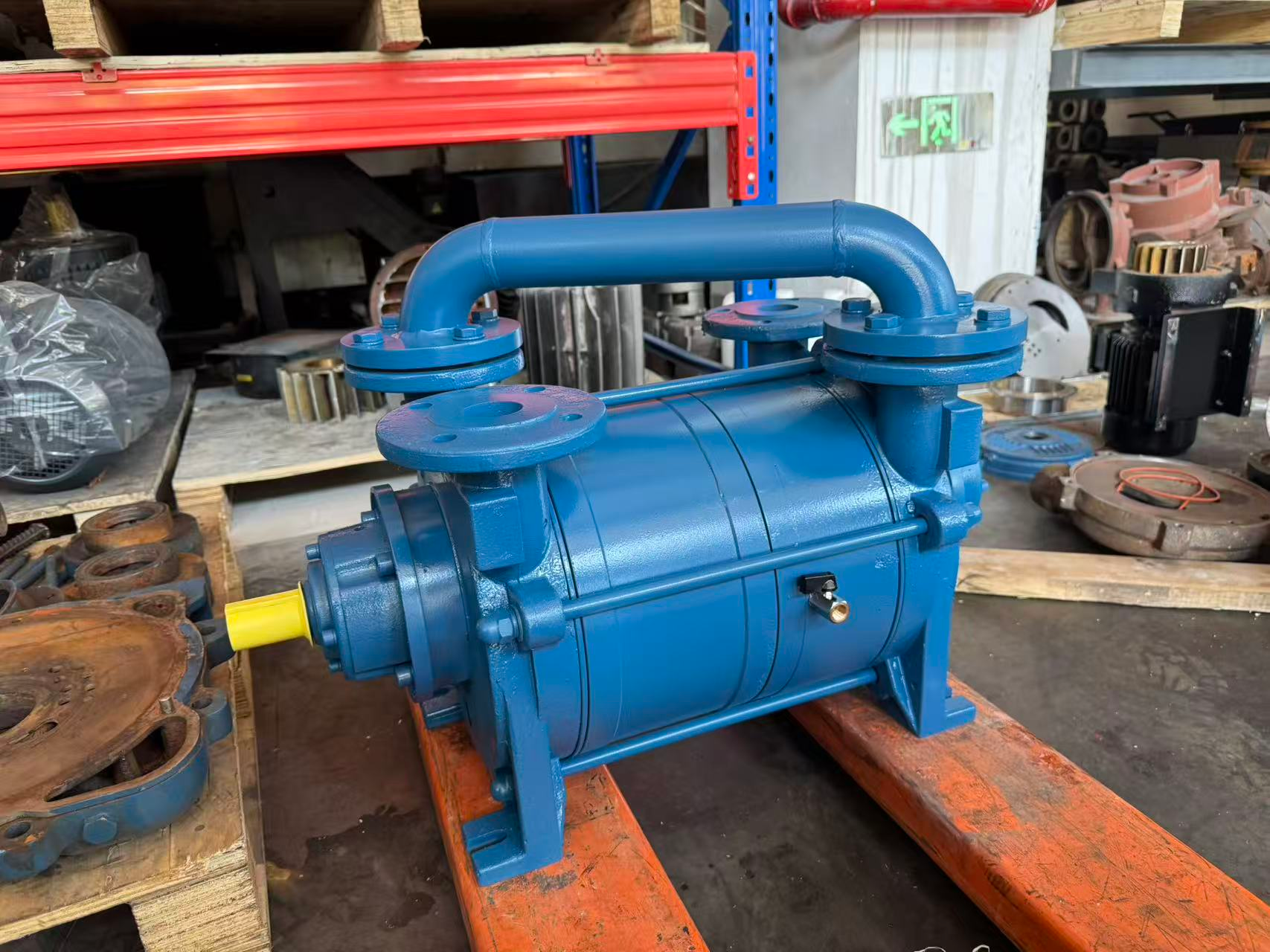
ZT Pumps 2S two-stage liquid ring vacuum pump. The pump must be selected according to its performance at the required operating pressure, not from ultimate pressure alone.
Why Maximum Capacity and Ultimate Pressure Must Not Be Mixed Together
Liquid ring pump brochures often present a maximum capacity and a maximum vacuum or ultimate pressure on the same page. Buyers can easily assume the two figures occur at the same operating point.
They often do not.
NASH, for example, publishes liquid ring performance with stated reference conditions and directs users to pump-specific performance data for sizing. Its CL-series data states that the illustrated performance is based on saturated air with 15.5°C seal water and 20°C suction temperature. [2]
This matters because liquid ring pump capacity depends on pressure and operating conditions.
When comparing quotations, ask:
- At what inlet pressure is the quoted capacity available?
- Is the flow stated as actual inlet volume or another reference basis?
- What are the seal-liquid and suction-gas temperatures?
- What discharge pressure is assumed?
- Is the value from a performance curve or only a nominal/free-air figure?
A meaningful comparison should use the same working pressure and comparable test conditions.
How to Read a Liquid Ring Vacuum Pump Performance Curve
A performance curve is more useful than a single ultimate-pressure number because it shows how capacity changes across the operating range.
For a selection at 600 mbar absolute:
- Find 600 mbar absolute on the pressure axis.
- Move to the pump's pumping-speed curve.
- Read the corresponding capacity.
- Compare that capacity with the process requirement.
- Check whether the curve is based on the same frequency, service liquid and temperature conditions as the proposed installation.
The same process applies at 300 mbar, 100 mbar or another operating point.
A conceptual curve might show strong capacity at higher inlet pressure and declining capacity as the pump approaches its low-pressure limit. The exact shape is model-specific, so a conceptual diagram should never be presented as a measured ZT Pumps curve.
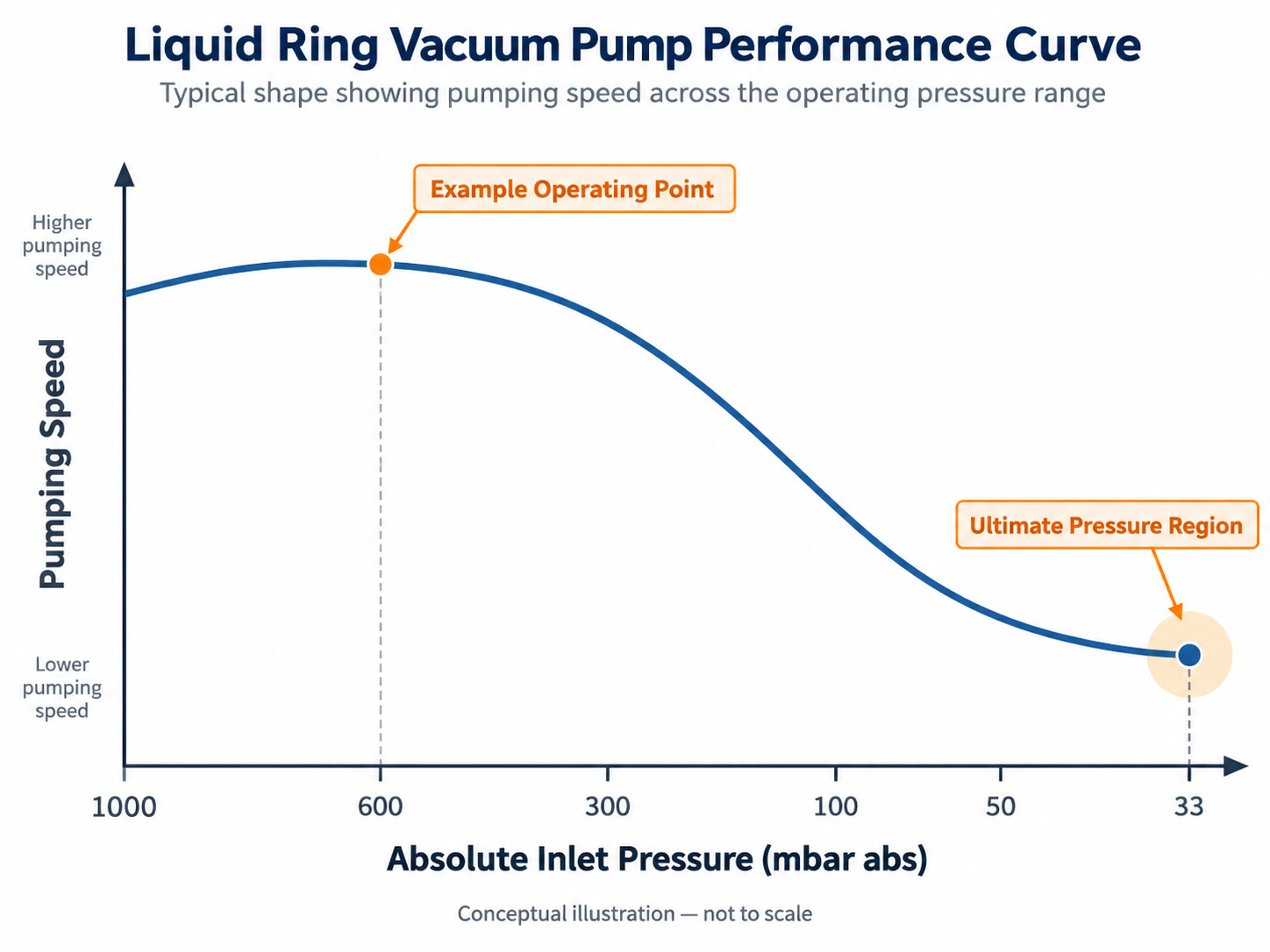
Conceptual illustration showing why liquid ring vacuum pump selection should be based on pumping speed at the required operating pressure rather than ultimate pressure alone. Not to scale.
A Useful Buying Rule
If a supplier gives you:
- maximum pumping speed;
- ultimate pressure;
- motor power;
but cannot provide performance information around your required working pressure, there is still an important gap in the selection.
For process applications, pressure-dependent performance matters more than comparing endpoint numbers alone.
A Real Selection Question: "But the Single-Stage Pump Also Reaches 33 mbar"
During an August 2025 discussion about a liquid ring pump for winery rotary vacuum filtration, a buyer raised a very reasonable question:
"But one stage rise 33 mbar too bro."
The important part of that exchange was not whether one pump could be declared universally better. It was that the buyer recognized a genuine selection problem: if different pump configurations show a similar ultimate-pressure value, the ultimate-pressure number alone cannot decide the application.
The buyer's next request was for the working curve.
That is exactly the correct direction.
For a real process, the next comparison should include:
- pumping speed in the required pressure range;
- continuous-duty conditions;
- vapor and liquid load;
- service-liquid temperature;
- materials;
- system pressure losses;
- installation and maintenance requirements.
A single endpoint such as 33 mbar cannot replace those checks.
Why Seal-Water Temperature Changes the Result
The service liquid is part of the vacuum-generation process. Its vapor pressure affects the low-pressure performance of the pump.
As water temperature rises, water-vapor pressure rises. This increases the vapor contribution inside the pump and can reduce attainable vacuum and pumping performance near the low-pressure end.
NASH notes that higher seal-water temperature can make the desired vacuum more difficult to achieve. [3] Busch similarly notes that liquid ring pumping performance depends on the vapor pressure of the service liquid, which is linked to its temperature and composition. [4]
This is why published performance curves must be read together with their test conditions.
A pump rated at 33 mbar under cool-water test conditions should not automatically be expected to reproduce exactly the same result with significantly warmer recirculated water.
What to Record in the Field
For troubleshooting or performance verification, record:
- seal-water supply temperature;
- seal-water discharge temperature;
- inlet gas temperature;
- inlet pressure;
- service-liquid flow;
- process vapor load.
Temperature is not a secondary detail. It can change the practical operating envelope.
Why a Closed-Loop System Needs Heat Removal
In a closed-loop liquid ring system, the working liquid is separated from the discharge gas and recirculated.
Because the pump and process add heat, the circulating liquid can become warmer over time unless heat is removed.
That is why a closed-loop arrangement may include:
- gas-liquid separator;
- circulation tank;
- heat exchanger;
- cooling-water circuit or chiller;
- temperature monitoring and control.
The purpose is not only water conservation. Temperature control also helps preserve predictable pump performance.
For demanding wet-vapor applications, condenser performance and seal-liquid cooling should therefore be evaluated as part of the vacuum system rather than treated as unrelated accessories.
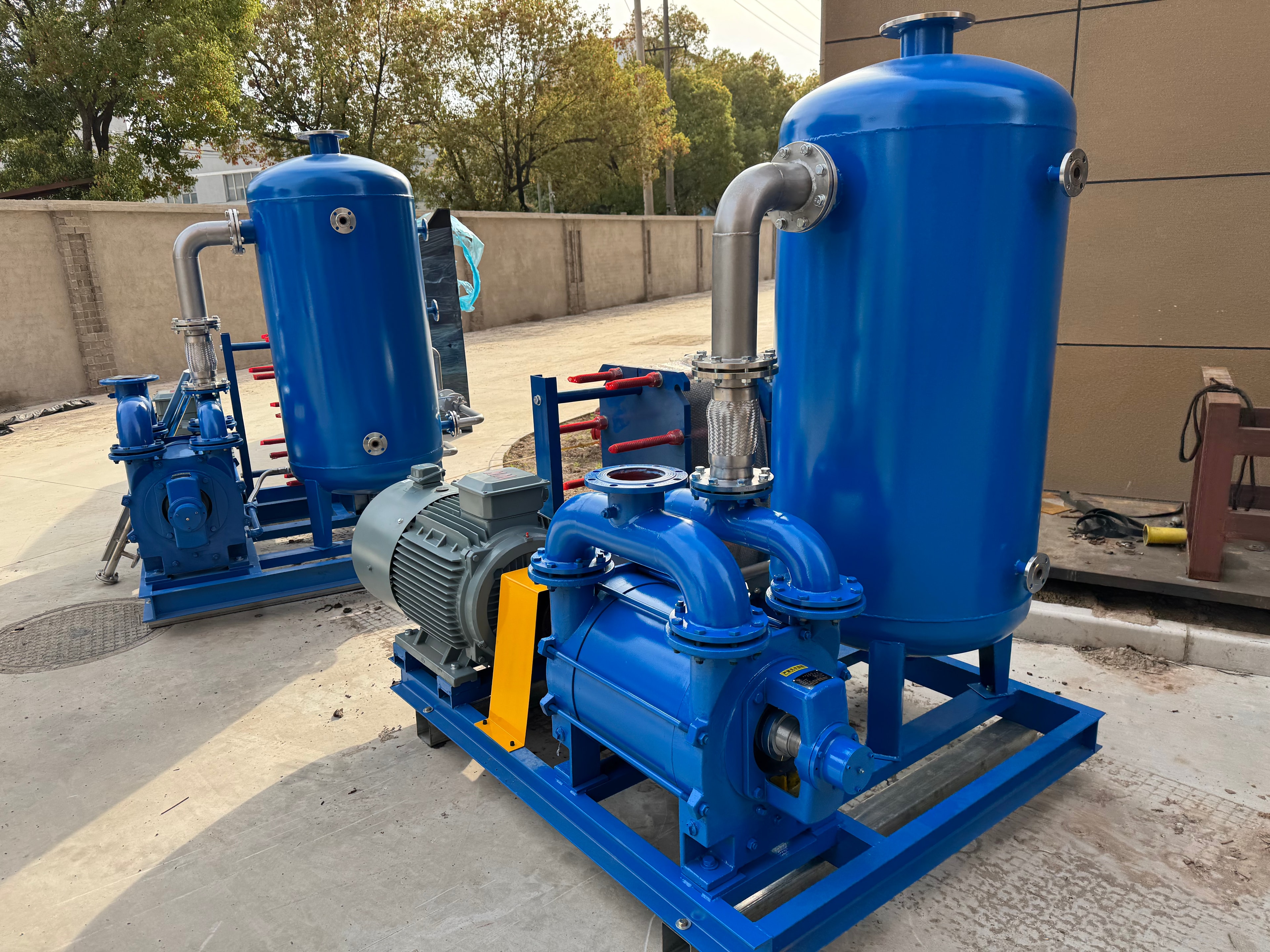
2S liquid ring vacuum pump system with a gas-liquid separator and plate heat exchanger for service-liquid circulation and temperature control.
What Happens Near the Ultimate-Pressure Region?
Operating very close to the service liquid's vapor-pressure limit can increase the risk of cavitation if conditions are unfavorable.
Busch describes cavitation as vapor-bubble formation at sufficiently low pressure and high operating-liquid temperature, followed by bubble collapse as pressure rises inside the pump. This can create noise, reduce performance and cause erosion. Busch recommends maintaining working pressure sufficiently above the vapor pressure of the operating liquid and using appropriate vacuum limitation or cavitation protection where required. [5]
This leads to an important engineering point:
The lowest number on the datasheet is not automatically the best continuous operating point.
Selection should allow appropriate operating margin and follow the specific manufacturer's permitted range and cavitation-protection requirements.
Single-Stage vs Two-Stage: The Same Ultimate Pressure Does Not Mean the Same Curve
This is another place where endpoint specifications can mislead buyers.
ZT Pumps currently lists both the single-stage 2BVA family and the 2S / 2S(F) two-stage family with ultimate pressure down to approximately 3300 Pa absolute under specified conditions. However, the 2S series is specifically designed for stronger pumping performance at lower inlet pressures. [6][7]
So if both datasheets say 33 mbar, the correct conclusion is not:
"They are the same."
Nor is it:
"Two-stage is automatically better."
The correct next step is:
Compare the performance curves in the pressure range your process actually uses.
A single-stage pump may be entirely appropriate at a moderate working pressure. A two-stage configuration becomes relevant when its low-pressure pumping characteristics, duty, materials and system fit offer an advantage for the defined application.
Why Published Test Conditions Matter
ZT Pumps' 2S data, for example, states specified test conditions including approximately 20°C air, 15°C operating water, atmospheric discharge pressure and defined air humidity. Actual pumping performance and ultimate pressure may vary with operating-liquid temperature and process conditions. [7]
NASH similarly states test-condition assumptions on its liquid ring performance data. [2]
This means a datasheet number should always be read together with:
- air/gas temperature;
- service-liquid temperature;
- discharge pressure;
- gas composition and humidity;
- frequency and speed;
- measurement basis.
If the field conditions are materially different, the expected performance may also be different.
What Information Should You Send Before Selecting a Liquid Ring Vacuum Pump?
"I need 240 m³/h" is not enough information for reliable liquid ring pump selection.
A useful enquiry should include:
| Information | Why It Matters |
|---|---|
| Required operating pressure, mbar absolute | Defines where the pump must actually work |
| Required pumping capacity at that pressure | Determines the needed performance at the operating point |
| Gas composition | Affects compatibility and performance |
| Water vapor / condensable load | Influences pump and upstream condenser requirements |
| Inlet gas temperature | Changes vapor load and gas density |
| Seal-water temperature | Strongly affects low-pressure performance |
| Service-liquid type | Determines vapor pressure and chemical compatibility |
| Open, partial or closed-loop system | Determines working-liquid management |
| Duty cycle / operating hours | Helps evaluate continuous-duty suitability |
| Voltage / frequency | Determines motor and speed configuration |
| Existing pump and piping information | Important for replacement and retrofit projects |
For a replacement project, also provide the existing pump nameplate, performance curve if available, inlet/outlet sizes and installation photographs.
Frequently Asked Questions
Does 33 mbar ultimate pressure mean the pump should normally run at 33 mbar?
No. It describes the low-pressure limit under specified conditions. The normal working pressure should be selected according to the process and the pump's performance curve.
Can a 33 mbar liquid ring pump work at 600 mbar absolute?
Potentially yes. The pump must have sufficient pumping speed at 600 mbar and the operating point must be within the permitted range for the specific model.
Is 33 mbar an absolute pressure?
Ultimate-pressure specifications for vacuum pumps are normally stated as absolute pressure when identified as mbar(a), mbara, Pa(abs.) or equivalent. Always confirm the datasheet convention before converting to gauge vacuum.
Is 3300 Pa the same as 33 mbar?
Yes. 3300 Pa equals 3.3 kPa or 33 mbar.
Does a lower ultimate pressure mean more pumping speed at 600 mbar?
No. Ultimate pressure alone does not tell you pumping speed at 600 mbar. Read the performance curve at the required operating pressure.
Why can a liquid ring pump fail to reach the published 33 mbar in the field?
Seal-liquid temperature, vapor load, leakage, piping restrictions, discharge conditions and pump condition can all affect the lowest stable pressure.
Does colder seal water improve vacuum?
Generally, lower service-liquid temperature reduces its vapor pressure and supports lower attainable pressure, provided the temperature remains within the pump manufacturer's permitted conditions.
Is a two-stage liquid ring pump always better than a single-stage pump?
No. The correct configuration depends on operating pressure, pumping-speed requirement, vapor load, system arrangement, materials and duty. Compare performance curves, not stage count alone.
Select the Pump at the Operating Point, Not at the Catalog Endpoint
The practical lesson is simple:
Do not select a liquid ring vacuum pump from the ultimate-pressure number alone.
A 33 mbar ultimate-pressure specification and a 600 mbar operating requirement are not contradictory. They answer different questions.
The engineering sequence should be:
- Define the required operating pressure.
- Define the pumping capacity needed at that pressure.
- Check the performance curve.
- Confirm service-liquid temperature and process conditions.
- Verify the permitted operating range and cavitation margin.
- Then compare pump series, motor size and system configuration.
Need Help Selecting a Liquid Ring Vacuum Pump?
Send ZT Pumps / Nantong Zhongtian Machinery Manufacturing Co., Ltd. your required operating pressure, required pumping speed, gas and vapor composition, inlet temperature, seal-liquid temperature, operating hours and available electrical supply.
For replacement projects, include the existing pump nameplate, curve and installation photographs.
ZT Pumps can help evaluate whether a standalone liquid ring pump, a closed-loop liquid ring system, or a Roots + liquid-ring configuration is appropriate for the application.
Request a liquid ring pump selection review
Technical References
[1] Flowserve — SIHI LEMD Liquid Ring Vacuum Pump. Operating suction-pressure range: 33 to 1013 mbar absolute. https://www.flowserve.com/products/products-catalog/pumps/vacuum-pumps/liquid-ring-vacuum-pumps/sihi-lemd-liquid-ring-vacuum-pump/
[2] NASH — CL Series Liquid Ring Vacuum Pumps. Performance data reference conditions include saturated air, 15.5°C seal water and 20°C suction temperature. https://www.nashpumps.com/en-nam/vacuum/liquid-ring-vacuum-pumps/cl-liquid-ring-pump-compressor/
[3] NASH — Monitoring Heat Exchanger Temperature. Higher seal-water temperature increases vapor pressure and can reduce vacuum performance. https://www.nashpumps.com/en-eur/knowledge-base/maintenance-tips/monitoring-heat-exchanger-temperature/
[4] Busch Vacuum Solutions — 3 Common Liquid Ring Vacuum Pump Mistakes. Service-liquid vapor pressure is linked to temperature and composition; performance curves commonly use defined seal-water temperature. https://www.buschvacuum.com/at/campaigns/common-vacuum-pumps-mistakes/white-paper-3-common-liquid-ring-vacuum-pump-mistakes.pdf
[5] Busch Vacuum Solutions — DOLPHIN LR Instruction Manual. Cavitation prevention and relationship between operating pressure and service-liquid vapor pressure. https://www.buschvacuum.com/cn/assets/60231/1/Instruction%20Manual%20DOLPHIN%20LR%200110-0580%20A_EN_en.pdf
[6] ZT Pumps — Liquid Ring Vacuum Pumps. Series comparison including 2BVA and 2S / 2S(F). https://ztpumps.com/products/liquid-ring-vacuum-pumps
[7] ZT Pumps — 2S / 2S(F) Two-Stage Liquid Ring Vacuum Pumps. Test-condition notes and low-pressure performance positioning. https://ztpumps.com/products/2s-two-stage
[8] ZT Pumps — How Does a Liquid Ring Vacuum Pump Work? https://ztpumps.com/blog/liquid-ring-vacuum-pump-working-principle
Explore Topics
Written by
Zhongtian Pumps Engineering Team
The Zhongtian Pumps Engineering Team specializes in industrial vacuum pump manufacturing, application engineering and vacuum system design. Nantong Zhongtian Machinery Manufacturing Co., Ltd. has manufactured industrial vacuum equipment since 2002.