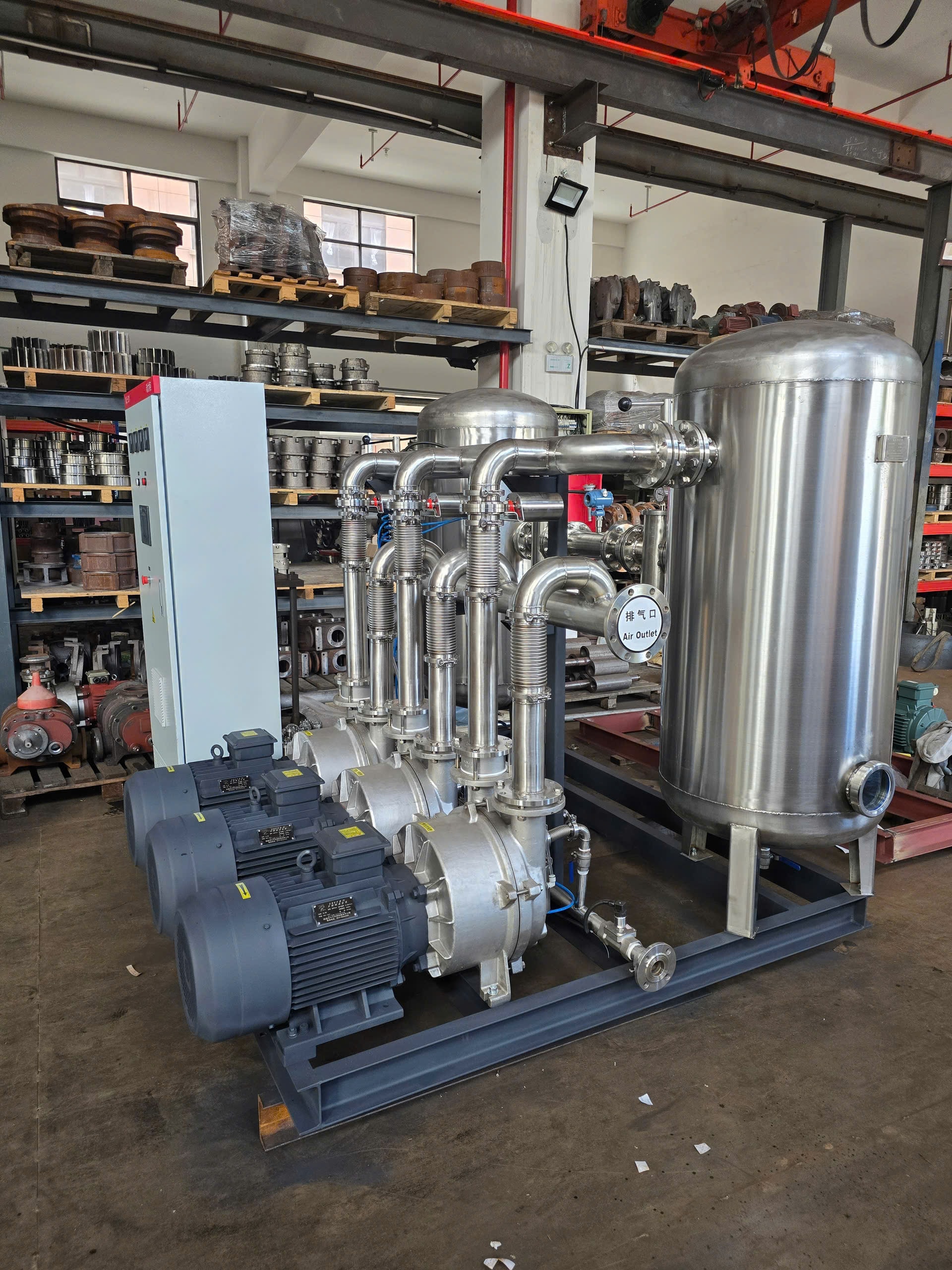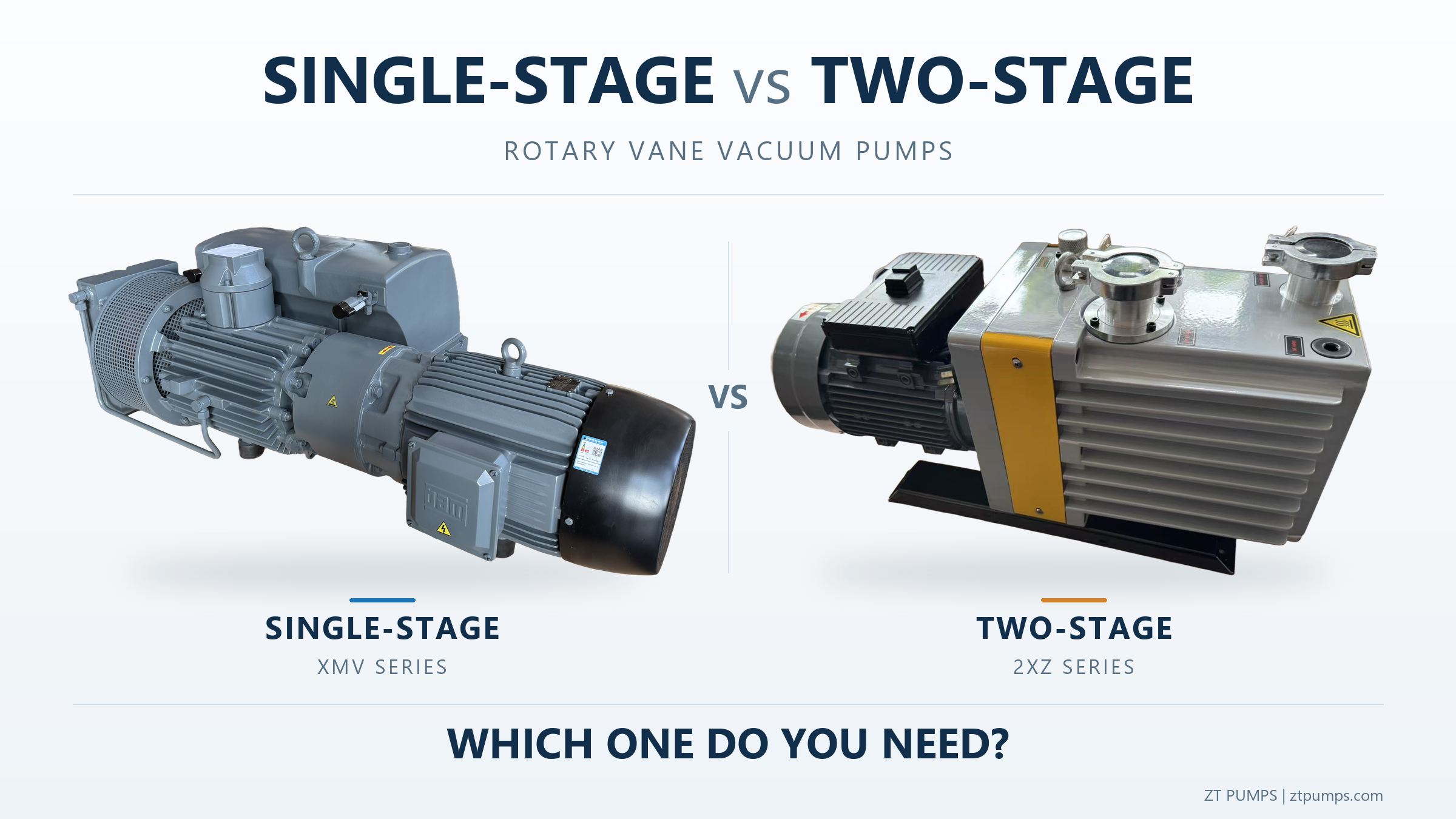
How to Select the Right Industrial Vacuum Pump: A Practical Guide
A step-by-step framework for selecting the right vacuum pump technology for your process — covering vacuum level, flow rate, gas composition, and total cost of ownership.

Selecting the wrong vacuum pump is an expensive mistake. A pump that cannot reach the required vacuum level will cause process failures. A pump that is oversized wastes energy. A pump that is incompatible with the process gas will fail prematurely and contaminate the product.
This guide provides a systematic framework for vacuum pump selection — one that our engineering team uses when working with customers across chemical, pharmaceutical, food, semiconductor, and power generation industries.
Step 1: Define the Required Vacuum Level
The first and most important parameter is the required absolute pressure at the pump inlet. Vacuum levels are typically expressed in one of several units:
| Unit | Atmospheric Pressure | High Vacuum |
|---|---|---|
| mbar | 1,013 mbar | < 0.001 mbar |
| Pa | 101,325 Pa | < 0.1 Pa |
| Torr | 760 Torr | < 0.001 Torr |
| mmHg | 760 mmHg | < 0.001 mmHg |
Vacuum Range Classification
- Rough vacuum: 1,013 – 1 mbar (atmospheric to 1 mbar)
- Medium vacuum: 1 – 0.001 mbar
- High vacuum: 0.001 – 10⁻⁷ mbar
- Ultra-high vacuum: Below 10⁻⁷ mbar
Most industrial processes operate in the rough to medium vacuum range. High and ultra-high vacuum are primarily used in research, semiconductor manufacturing, and specialized coating applications.
Practical tip: Specify where the required absolute pressure must be achieved: at the process vessel or at the pump inlet. A pump's ultimate pressure must be below the required operating pressure, but a 5 mbar ultimate-pressure rating does not by itself confirm suitability for a 10 mbar process. Check the pumping speed at the working pressure, the expected gas load, and pressure losses through the actual pipework.
Step 2: Determine the Required Pumping Speed
Pumping speed (also called volumetric flow rate) is the volume of gas the pump can remove per unit time, expressed in m³/h or L/s. It determines how quickly the system can be evacuated and how well it can maintain vacuum against process gas loads.
Calculating Required Pumping Speed
The required pumping speed depends on:
- System volume: Larger systems need higher pumping speed to achieve target vacuum in a reasonable time
- Process gas load: The rate at which gas is generated or admitted during the process
- Acceptable pump-down time: How quickly the system must reach operating pressure
A simplified estimate for evacuating a fixed-volume chamber is shown below. It assumes approximately constant gas temperature and effective pumping speed at the chamber, negligible continuing gas load from leaks, outgassing or process vapors, and a pump ultimate pressure that is negligible compared with the target pressure:
t = (V / S) × ln(P₁ / P₂)
Where:
- t = pump-down time (hours)
- V = system volume (m³)
- S = effective pumping speed at the chamber (m³/h), after piping and component losses; this is not automatically the pump's catalog-rated speed
- P₁ = starting absolute pressure (mbar)
- P₂ = target absolute pressure (mbar)
Example: Under these assumptions, evacuating a 10 m³ system from 1,013 mbar to 10 mbar in 30 minutes (0.5 hours) requires approximately:
S = V × ln(P₁/P₂) / t = 10 × ln(101.3) / 0.5 = 10 × 4.62 / 0.5 = 92 m³/h
The 92 m³/h result is an idealized effective speed at the chamber. An illustrative 20–30% allowance gives about 110–120 m³/h, but this is not a guaranteed pump rating or a universal selection margin. Catalog-rated pumping speeds are useful for shortlisting candidate series; confirm the final model using its pressure-dependent performance, the actual pipework, gas load and operating conditions. Significant gas generation or a target close to the pump's ultimate pressure requires a more detailed calculation.
Step 3: Characterize the Process Gas
The composition of the gas being pumped is often the most critical factor in pump selection. Key questions to answer:
Is the Gas Wet or Dry?
Wet gas may contain condensable vapor; entrained liquid droplets are a separate condition.
Liquid ring pumps are often suitable candidates, subject to gas and working-liquid compatibility, working-liquid temperature and supply flow, and the selected model's liquid-handling limits. Liquid carryover may require an inlet knock-out separator.
Oil-sealed rotary vane pumps may handle condensable vapor only within the selected model's specified vapor-pressure and vapor-capacity limits, at the required operating temperature and with the specified gas-ballast setting, where fitted. Gas ballast does not make a pump suitable for liquid ingestion; an inlet condenser or separator may be needed for the actual process.
Dry gas opens up more pump technology options, including dry screw and rotary vane designs.
Is the Gas Corrosive?
Identify all corrosive components — acids, halogens, oxidizers, and reactive organic compounds. For corrosive gas applications:
- Liquid ring pumps: Available in stainless steel, duplex stainless, and special alloys. The service liquid can be selected to be compatible with the process gas
- Dry screw pumps: Available with nickel plating, PTFE coating, or special alloy construction for corrosive applications
- Rotary vane pumps: Generally not suitable for strongly corrosive gases
Is the Gas Flammable or Explosive?
For flammable gases or potentially explosive atmospheres, confirm the gas mixture, operating conditions, hazardous-area classification, and required protection with the equipment manufacturer before selecting a pump.
- Liquid ring pumps: The service liquid limits compression heating, but liquid ring technology alone does not establish explosion protection. Confirm the exact pump and system configuration and any required certification.
- Dry screw pumps: Dry compression does not remove ignition risks. Use only a configuration confirmed for the duty, including the manufacturer's specified purge/barrier-gas and temperature controls.
- Rotary vane pumps: Do not assume a standard oil-sealed pump is suitable. Confirm the exact model's suitability, operating limits, and required safeguards with its manufacturer.
Does the Gas Contain Particulates?
Particulates can cause rapid wear in pumps with tight clearances. For gas streams containing dust or solid particles:
- Install an inlet filter upstream of the pump
- Consider liquid ring pumps, which are more tolerant of particulate contamination
- Avoid dry screw pumps without adequate inlet filtration
Is the Gas Toxic?
For toxic gas applications, the pump exhaust must be treated before discharge to atmosphere. Consider the pump's exhaust connection and ensure it is compatible with your abatement system.
Step 4: Match Technology to Requirements
With vacuum level, pumping speed, and gas composition defined, you can now match the appropriate pump technology:
Liquid Ring Vacuum Pumps
Best for:
- Wet gas and condensable vapors, with compatible working liquid and temperature/flow control; liquid carryover must stay within the selected pump/system's limits
- Corrosive gases (with appropriate materials)
- Flammable gas duties only with a pump/system confirmed for the specific gas, operating limits, and required protection
- Large flow rates at moderate vacuum (down to 33 mbar single-stage, 25 mbar two-stage)
- Applications where simplicity and robustness are priorities
Not ideal for:
- Deep vacuum below 25 mbar (without Roots booster)
- Applications requiring oil-free, dry vacuum
Rotary Vane Vacuum Pumps
Best for:
- Deep vacuum applications (down to 0.5 Pa oil-sealed)
- Clean, dry gas streams
- Laboratory and analytical instrument backing
- Compact, portable applications
- Moderate flow rates (up to 600 m³/h)
Not ideal for:
- Liquid carryover or vapor loads beyond the selected model's limits, even when gas ballast is available
- Corrosive gases
- Large flow rates
Dry Screw Vacuum Pumps
Best for:
- Applications requiring oil-free vacuum
- Corrosive process gases (with appropriate surface treatment)
- Condensable vapors (with heating)
- Semiconductor, pharmaceutical, and fine chemical processes
- Medium vacuum range (0.01–1 mbar)
Not ideal for:
- Target pressures outside the selected model's verified operating range. If a turbomolecular high-vacuum stage is required, it needs a matched backing pump selected for the required forevacuum pressure and gas load.
- Applications where initial cost is the primary constraint
Roots Vacuum Boosters
Best for:
- Extending the vacuum level of an existing backing pump
- High pumping speed at low pressures
- Large-volume systems requiring fast pump-down
- Always used in combination with a backing pump
Not suitable for:
- Standalone operation (must have a backing pump)
Step 5: Consider Total Cost of Ownership
Purchase price is only one component of vacuum pump cost. A complete TCO analysis should include:
Energy Consumption
Vacuum pumps run continuously in many processes. A 10% improvement in pump efficiency can save significant energy costs over a 10-year service life. Request power consumption data at your actual operating pressure, not just at maximum flow.
Maintenance Costs
- Oil-sealed pumps: Include pump oil, used-oil disposal and applicable filter replacements in the budget. Follow the selected model's maintenance manual; oil condition, process contamination and operating conditions affect service needs.
- Liquid ring pumps: Allow for working-liquid management, cleaning and scale control where required, plus seal or packing and bearing maintenance appropriate to the selected model and configuration.
- Dry screw pumps: Dry compression uses no sealing oil in the pumping chamber, but lubrication outside the chamber, cooling, purge systems and cleaning may still require service, depending on the design. Request a model- and process-specific maintenance schedule and cost estimate.
Downtime Costs
In continuous processes, unplanned pump downtime can be extremely costly. Consider:
- Mean time between failures (MTBF) for each technology
- Availability of spare parts and service support
- Whether a standby pump is required
Process Impact
A pump failure or performance degradation that causes process upsets, product loss, or quality issues can dwarf the cost of the pump itself. Factor in the cost of process reliability when comparing pump options.
Step 6: Verify Mechanical and Installation Requirements
Before finalizing pump selection, confirm:
- Inlet connection size and type: Must match your piping
- Discharge connection: Must be compatible with your exhaust treatment system
- Motor voltage and frequency: Must match your electrical supply
- Cooling requirements: Water-cooled vs. air-cooled; cooling water flow rate and temperature
- Footprint and weight: Must fit in the available space
- Noise level: Must comply with workplace noise regulations
- Vibration: Consider isolation mounts for sensitive installations
Quick Selection Reference
| Requirement | Recommended Technology |
|---|---|
| Wet gas, moderate vacuum (>25 mbar) | Liquid ring pump |
| Wet gas, deep vacuum (<25 mbar) | Liquid ring + Roots booster |
| Corrosive gas, medium vacuum | Dry screw pump |
| Clean dry gas, deep vacuum | Oil-sealed rotary vane |
| Oil-free, medium vacuum | Dry screw pump |
| High pumping speed at low pressure | Roots booster + backing pump |
| Flammable gas, ATEX | Pump/system specifically confirmed for the gas, operating conditions, and ATEX requirements |
| Large flow, rough vacuum | Liquid ring or Roots booster |
Conclusion
Systematic vacuum pump selection — starting with vacuum level, pumping speed, and gas composition, then matching technology to requirements and evaluating total cost of ownership — leads to better decisions and lower lifetime costs.
Use our vacuum pump selector to identify candidate series for engineering review.
Zhongtian Pumps' engineering team has supported vacuum system design across chemical, pharmaceutical, food, power, and semiconductor industries for over 20 years. We offer free application engineering consultations to help you select the right pump for your process. Contact our engineering team with your process parameters and we will recommend the optimal solution.
Explore Topics
Written by
Zhongtian Pumps Engineering Team
The Zhongtian Pumps Engineering Team specializes in industrial vacuum pump manufacturing, application engineering and vacuum system design. Nantong Zhongtian Machinery Manufacturing Co., Ltd. has manufactured industrial vacuum equipment since 2002.