Single-Stage vs Two-Stage Rotary Vane Vacuum Pumps: Which One Do You Need?
Compare single-stage and two-stage rotary vane vacuum pumps by operating pressure, pumping speed, vapor load and duty cycle—not stage count alone.

A vacuum pump can have a lower ultimate-pressure specification without being the better choice for your machine. Before replacing a single-stage pump with a two-stage model, establish whether the process needs lower pressure, faster evacuation, or better handling of its gas load.
Choose a suitable single-stage pump when it meets the operating pressure, pumping capacity and duty cycle. Evaluate a two-stage pump when lower-pressure performance is required. Two stages do not automatically mean twice the pumping speed. Corresponding two-stage oil-sealed designs can reach lower pressures than single-stage designs, but the actual result remains model- and application-dependent. [1,2]
This guide covers oil-sealed rotary vane pumps for industrial and OEM applications. It does not compare oil-free rotary vane designs. All pressure values are absolute unless stated otherwise.
What Does "Stage" Mean in a Rotary Vane Vacuum Pump?
A stage is a compression stage—not a vane, a motor or a quality grade.
A single-stage pump draws gas through one compression stage before discharge. A two-stage pump passes gas through two compression stages in series: the inlet-side stage discharges into the second stage rather than directly against atmospheric pressure. [1,2]
The simplified gas paths are:
Single-stage: Inlet → one compression stage → exhaust.
Two-stage: Inlet → first compression stage → second compression stage → exhaust.
These are internal compression arrangements, not instructions to connect two complete pumps together. They are also separate from the choice between belt drive and direct coupling. Zhongtian's 2XZ manual, for example, describes two working chambers in series and a motor-to-pump coupling. [3]
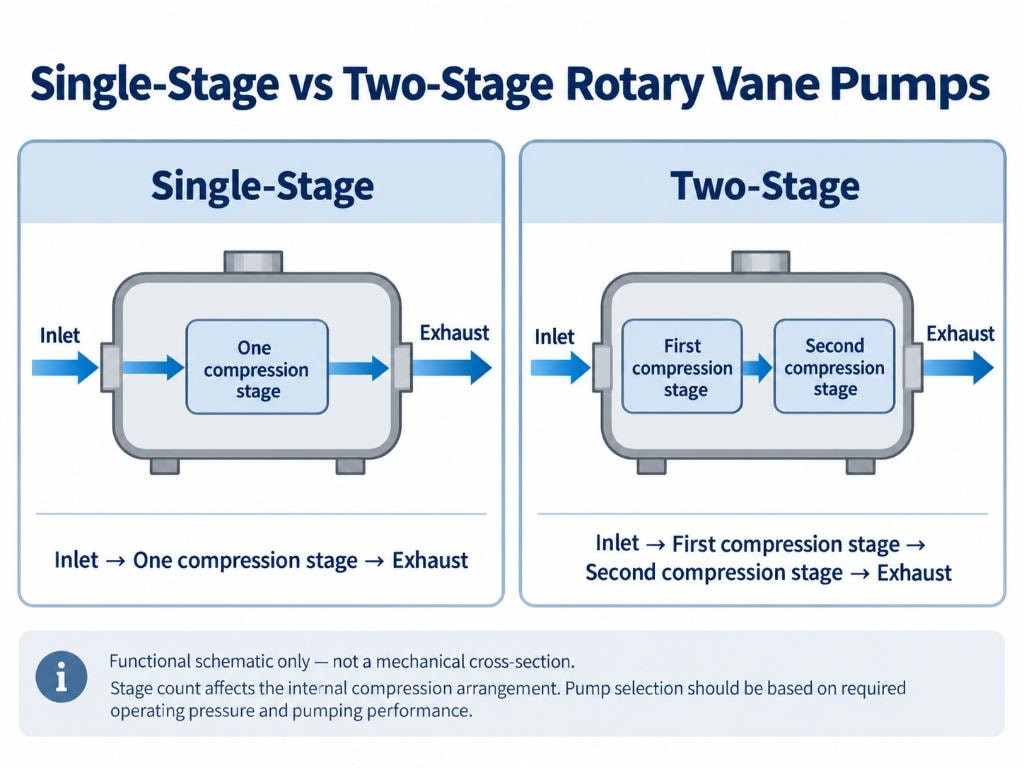
One-stage and two-stage internal compression arrangements. The diagram explains gas flow, not pumping-speed ratios or the connection of separate pumps.
Single-Stage vs Two-Stage: Practical Comparison
Use this table to organize a model comparison, not as a universal performance specification. The structural distinction comes from the pumping principle; operating limits, vapor capability and servicing must be checked separately. [1,2,4,5,11]
| Selection factor | Single-stage oil-sealed pump | Two-stage oil-sealed pump |
|---|---|---|
| Compression arrangement | One compression stage | Two compression stages in series |
| Lower-pressure capability | May be sufficient for the process | Corresponding designs generally allow lower operating and ultimate pressures |
| Pumping speed | Read the model's curve at the required pressure | Read the model's curve; stage count is not a capacity multiplier |
| Continuous operation | Confirm the permitted inlet-pressure and temperature range | Confirm the permitted range and exact configuration |
| Water vapor | Check gas ballast, vapor tolerance and handling capacity | Check the same parameters; two stages alone do not establish suitability |
| Oil and servicing | Oil condition, seals and fitted filters still matter | Oil condition, seals and fitted filters still matter |
| Purchasing decision | Select when documented performance meets the duty | Select when the additional low-pressure capability is needed and the duty is suitable |
Does a Two-Stage Pump Evacuate a Chamber Faster?
Not necessarily. Pump-down time depends on chamber volume, the pressure interval, effective pumping speed and gas released or admitted during evacuation. A lower limiting pressure is useful only if the pump also provides suitable performance over the required cycle. [6]
Consider a hypothetical purchase comparison: a single-stage pump quoted at 100 m³/h and a two-stage pump quoted at 8 L/s. The latter equals 28.8 m³/h, because 1 L/s = 3.6 m³/h. These are illustrative capacities, not a comparison of specific ZT Pumps models.
For a process targeting 50 mbar, first confirm that both candidates can operate there under the actual load. Then compare their pumping-speed curves. The two-stage candidate must not be assumed faster simply because its catalog lists a lower ultimate pressure. If the target is later reduced beyond the single-stage candidate's capability, the selection may change.
Do not calculate a guaranteed cycle time from nominal capacity alone. Connecting pipes, valves and protective devices restrict flow, so the effective pumping speed at the chamber can be lower than the speed at the pump inlet. [7]
When Is a Single-Stage Pump the Right Choice?
A single-stage pump is a reasonable candidate when the required operating point lies within its documented performance envelope and it provides adequate capacity throughout the cycle.
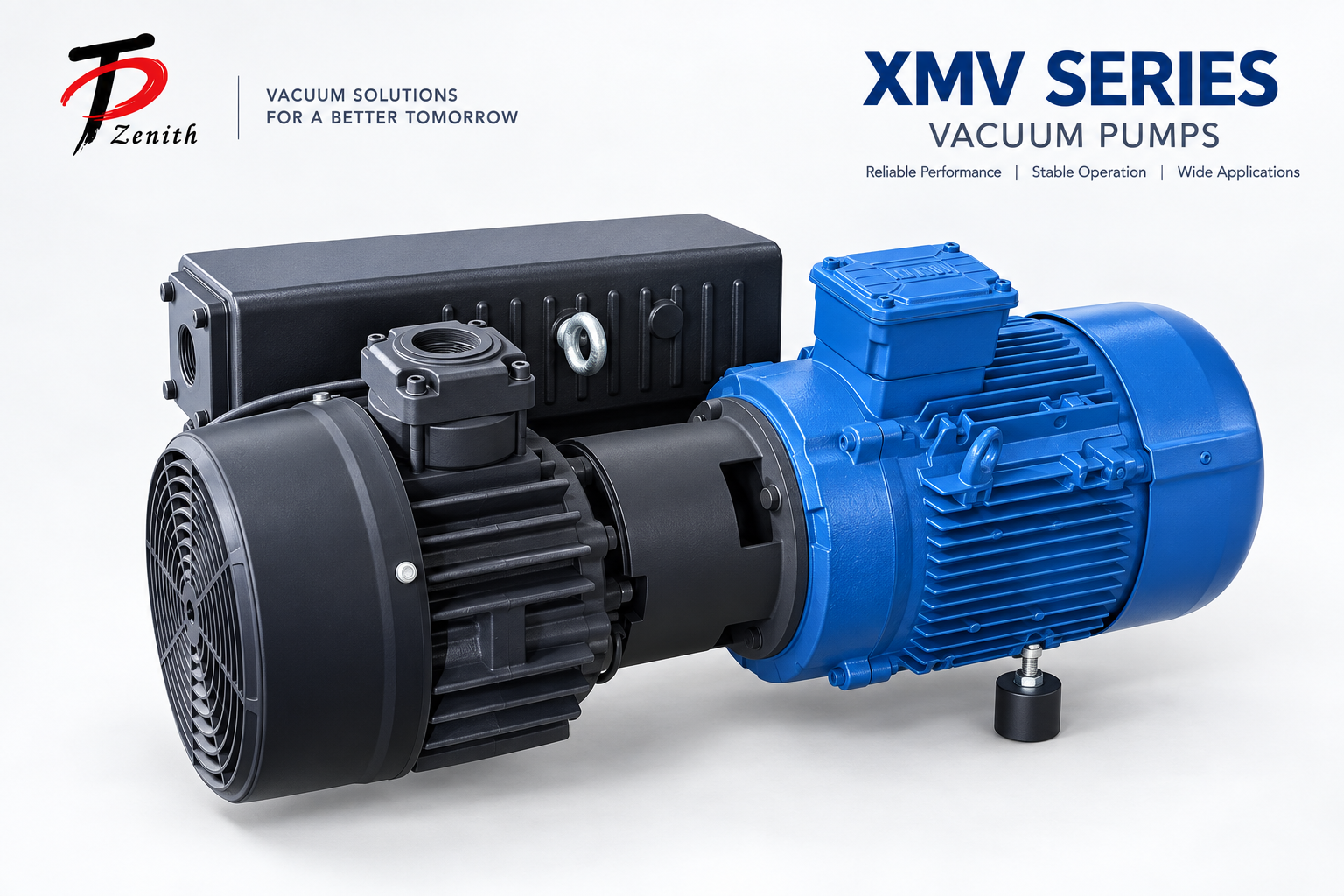
Single-stage oil-sealed rotary vane vacuum pump for applications within the supplied model's operating envelope.
This is not a "basic versus advanced" purchasing decision. Commercial single-stage ranges include different pumping speeds, ultimate pressures, gas-ballast options and vapor-handling ratings. There is no single pressure limit that describes every single-stage rotary vane pump. [4]
For an OEM machine already meeting its pressure requirement, ask what an upgrade should improve. Is the goal a shorter cycle, additional capacity, less maintenance or a smaller installation? Specify that outcome before selecting a different compression arrangement.
If the proposed single-stage model already meets the complete duty, a lower catalog pressure from another pump is not, by itself, a reason to change.
When Do You Need a Two-Stage Pump?
Evaluate a two-stage pump when the process needs lower pressure than the candidate single-stage model can reliably provide under load. The second compression stage supports lower-pressure operation in corresponding designs, rather than acting as an automatic increase in volumetric capacity. [1]
Request pumping-speed data near the intended operating pressure. A catalog endpoint is not evidence that the pump can remove the required continuous gas load at that same pressure.
Zhongtian's 2XZ instructions describe the pump as a two-stage direct-coupled design that can work independently or serve as a backing or preliminary evacuation pump in an appropriate higher-vacuum system. That is a statement about its documented role, not approval for every process or system combination. [3]
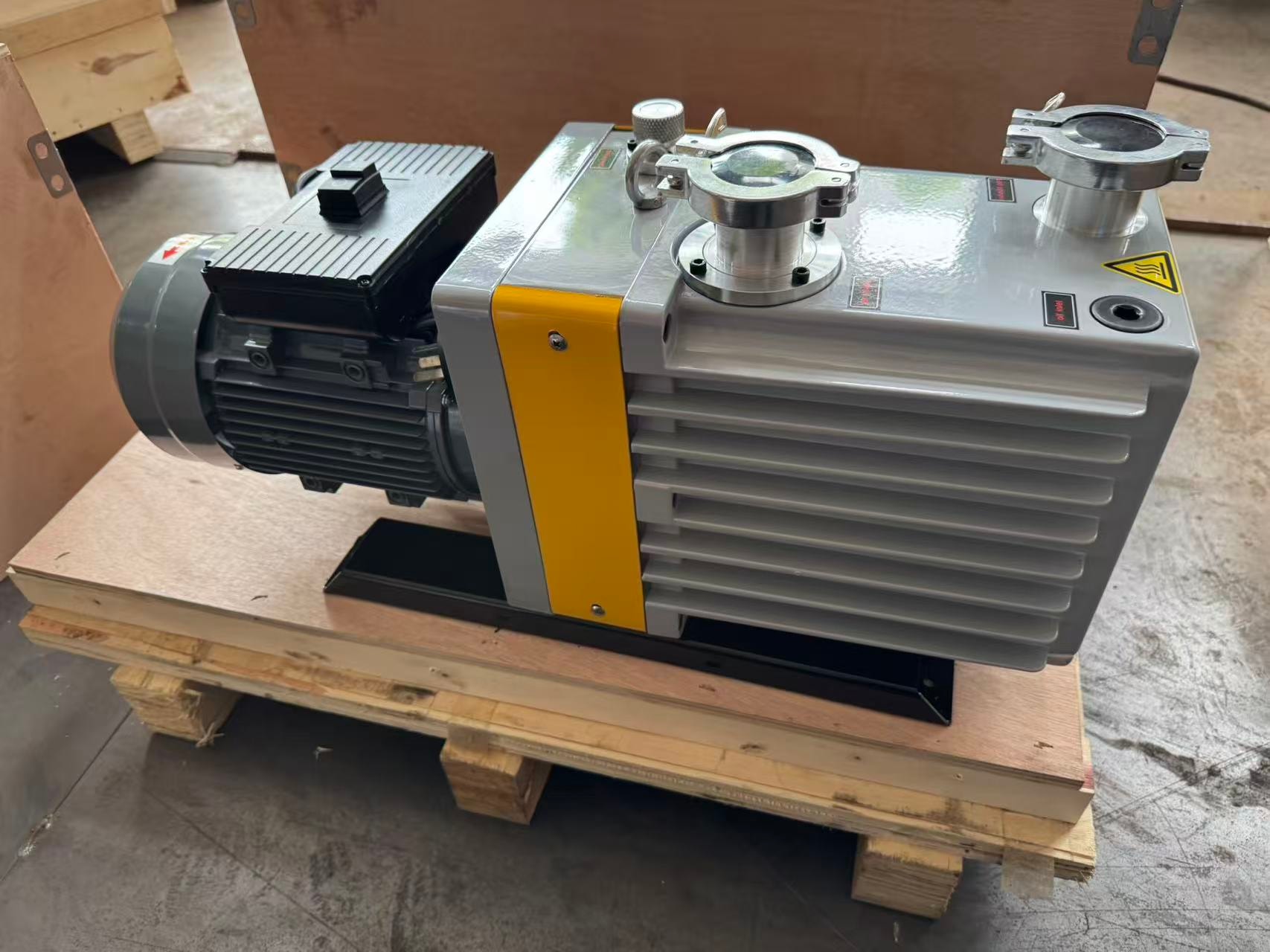
Two-stage oil-sealed rotary vane vacuum pump. Selection should be based on the required operating pressure and pumping performance, not stage count alone.
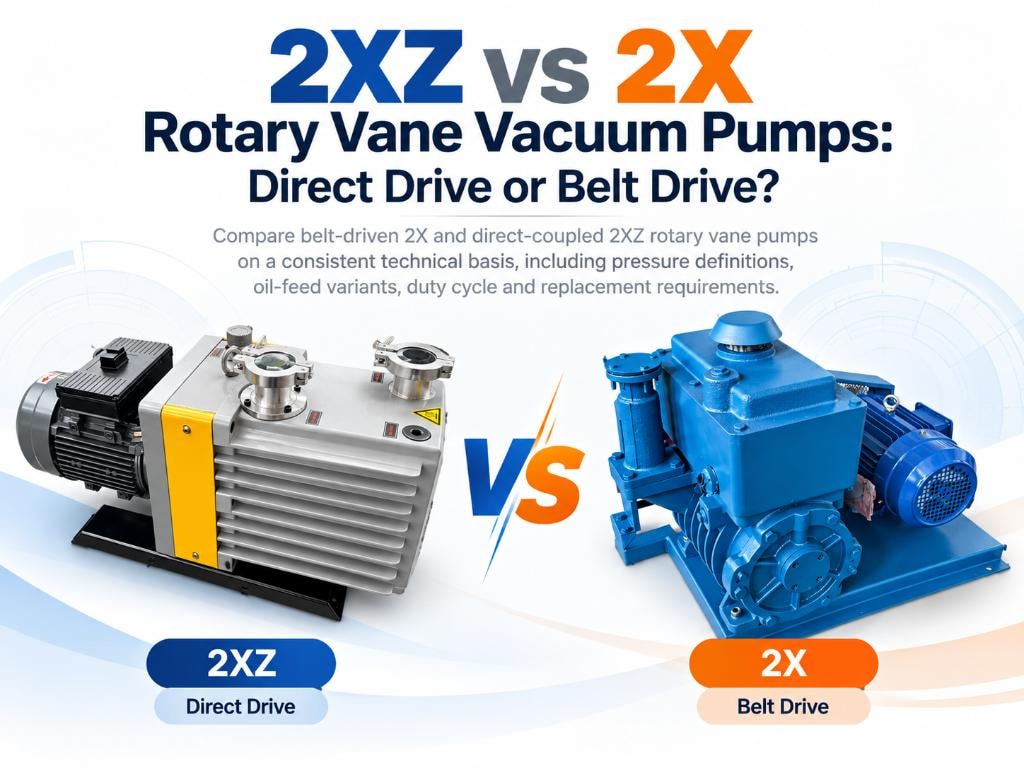
Once a two-stage configuration has been selected, the separate question of mechanical layout can be addressed. Our guide to 2X vs 2XZ: direct drive or belt drive explains that comparison.
Compare Working Pressure, Not Just Ultimate Pressure
Three terms should remain distinct:
Ultimate pressure is the limiting pressure under the specified test conditions. Operating pressure is the pressure required while the process is running. Pumping speed describes volumetric removal at the stated inlet conditions.
The final system pressure also depends on gas sources, leak tightness and the condition of the pumping system. Do not assume that a chamber releasing gas will operate at the pump's no-load limit. [8]
Use the same measurement basis when comparing suppliers. "Ultimate partial pressure" and "ultimate total pressure" are not interchangeable specifications. Confirm the gauge, measurement location, gas-ballast state and test conditions before ranking two numbers. [8]
For the measurement question, see rotary vane pump ultimate pressure and Pirani gauge readings. Keep that acceptance-test discussion separate from the decision about the number of compression stages.
Does a Two-Stage Pump Handle Water Vapor Better?
Stage count alone does not answer this question. Water-vapor handling depends on factors including gas-ballast flow, operating temperature and pump design. Manufacturers distinguish vapor tolerance from vapor-handling capacity; both should be checked against the process. [4,5]
Where the pump and application permit it, gas ballast helps limit condensation during compression. Evaluate the required pressure with the gas-ballast setting needed in service, rather than comparing only gas-ballast-closed catalog figures. [4,5]
Zhongtian's XMV manual also describes a gas-ballast valve. Vapor management is therefore not a feature exclusive to two-stage products. Follow the instructions for the actual supplied model. [9]
For a wet application, separate the two protection tasks: removing entrained liquid droplets and reducing vapor load. A suitable inlet separator addresses liquid carryover; a suitably designed condenser can remove vapor when the temperature and vapor partial pressure allow condensation. These are system-design decisions—not benefits obtained merely by adding a compression stage. [12,13]
Gas ballast is not permission to ingest liquid. Corrosive, toxic, flammable or oxygen-rich duties require application-specific compatibility and safety review; a standard pump must not be assumed suitable because it is two-stage. [3]
Continuous Duty, Maintenance and Running Cost
A pump's stage count does not define its complete operating envelope. Check permitted inlet pressure, gas temperature, cooling conditions and the supplied lubrication configuration. A short atmospheric pump-down and prolonged operation at an elevated inlet pressure are different duties. [3,10]
Both pump types in this article are oil-sealed. Oil condition, level, leak checks and servicing of fitted filters remain relevant. Adding a second stage does not create an oil-free pumping path or eliminate oil-related contamination concerns. [11]
Zhongtian's 2XZ manual distinguishes self-suction oil feed from an oil-pump-fed version identified there by a "C" suffix. This is a reason to confirm the exact variant—not to assume that all models sharing a series name have identical operating limits. [3]
For ownership cost, request comparable quotations covering the required motor, exhaust treatment, inlet protection and spare parts. Compare energy use over the intended operating cycle where data are available. Do not declare one stage count universally quieter, cheaper or more efficient without a defined model comparison.
Selecting Between ZT Pumps Product Families
Zhongtian's documentation identifies XMV as a single-stage rotary vane family and 2XZ as a two-stage direct-coupled family. Those descriptions help organize the initial selection; they do not replace the current datasheet for the exact unit. [3,9]
For an enquiry covering XD/XMV single-stage products or 2X/2XZ two-stage products, identify the required process duty first. Where a replacement carries a different series name or suffix, confirm the model correspondence, installation dimensions and supplied configuration rather than treating the names as interchangeable.
A useful selection request contains the following information:
| Information to provide | What it helps establish |
|---|---|
| Target operating pressure and where it is measured | The actual process requirement, not only a pump-inlet value |
| Chamber volume, start pressure and required pump-down time | The evacuation task and relevant pressure interval |
| Continuous gas flow and vapor load, with units and reference conditions | The load the pump must handle after initial evacuation |
| Gas composition, liquid carryover and particles | Compatibility and upstream protection requirements |
| Duty cycle, gas temperature and ambient conditions | Whether the proposed operating point is permitted |
| Voltage, frequency and phase | The correct motor configuration and applicable performance data |
| Existing nameplate, piping, mounting dimensions and photographs | Replacement compatibility and installation constraints |
This is a procurement checklist. Final suitability still requires the current manufacturer data and, where necessary, an agreed application test.
Frequently Asked Questions
Does Two-Stage Mean Twice the Pumping Speed?
No. The stages are arranged in series for compression. Compare measured pumping-speed curves at the intended pressure; do not multiply the quoted capacity by two. [2,6]
Must Every Process Below 1 mbar Use a Two-Stage Pump?
No universal 1 mbar boundary applies. Some single-stage models specify ultimate total pressures below that value, but a no-load rating does not establish suitability for a loaded process. Check the exact curve and operating limits. [4]
Does Two-Stage Mean Belt-Driven?
No. Compression-stage count and motor transmission are separate design choices. Zhongtian's two-stage 2XZ, for example, is direct-coupled. Identify both characteristics in the product documentation rather than inferring one from the other. [3]
Can I Replace a Single-Stage Pump with a Two-Stage Pump of the Same Nominal Capacity?
Possibly, but it is not an automatic drop-in replacement. Review pressure-dependent performance, duty, gas compatibility, connections, dimensions, electrical supply and system isolation requirements before ordering.
Choose the Required Performance, Not the Larger Stage Count
The correct pump is the one that meets the operating pressure, gas load and cycle requirements with a suitable installation and service plan. Single-stage and two-stage designs provide different options; neither is the universal answer to every vacuum problem.
Request a Rotary Vane Pump Selection Review
Send ZT Pumps / Nantong Zhongtian Machinery Manufacturing Co., Ltd. your target operating pressure, chamber volume, pump-down requirement, gas and vapor details, duty cycle and available power supply. For replacement projects, include the existing pump nameplate and installation photographs.
Review our rotary vane vacuum pump range, or request a pump selection review to compare suitable single-stage and two-stage configurations on a consistent technical basis.
Technical References
[1] Leybold — How does a rotary vane pump work? https://www.leybold.com/en-us/knowledge/vacuum-fundamentals/vacuum-generation/how-does-an-oil-sealed-rotary-displacement-pump-work General compression-stage principles and comparison of corresponding oil-sealed designs.
[2] Busch — Rotary Vane Vacuum Pumps and Compressors https://www.buschvacuum.com/ee/en/products/vacuum-pumps/rotary-vane/rotary-vane-technology/ Single- and two-stage construction and the distinction from dry-running variants.
[3] Nantong Zhongtian — 2XZ Direct-Coupled Rotary Vane Vacuum Pump Operating Instructions Manufacturer document supplied for this project; sections 1, 3 and 4. Revision date not established. Model-specific limits require the current instructions for the supplied unit.
[4] Leybold — SOGEVAC B Single-Stage Rotary Vane Vacuum Pumps https://www.leybold.com/en-uk/products/vacuum-pumps/oil-sealed-vacuum-pumps/rotary-vane-pumps-sogevac-b Examples of separately specified pumping speed, ultimate total pressure and vapor ratings; not ZT Pumps specifications.
[5] Edwards — Why gas ballast is important on oil-sealed rotary vane pumps https://www.edwardsvacuum.com/en-us/vacuum-pumps/knowledge/applications/why-gas-ballast-is-important-on-oil-sealed-rotary-vane-pumps Vapor-handling factors and oil-conditioning considerations.
[6] Leybold — How to calculate pump-down time https://www.leybold.com/en-uk/knowledge/vacuum-fundamentals/vacuum-generation/calculating-pump-down-time Effective pumping speed, pressure interval, volume and gas-load considerations.
[7] Leybold — How is conductance in vacuum calculated? https://www.leybold.com/en/knowledge/vacuum-fundamentals/fundamental-physics-of-vacuum/how-to-calculate-vacuum-conductance Piping restrictions and effective pumping speed at a vessel.
[8] Leybold — How is vacuum pressure measured? https://www.leybold.com/en/knowledge/vacuum-fundamentals/fundamental-physics-of-vacuum/units-and-ranges-of-pressure Absolute pressure, total/partial pressure and ultimate-pressure terminology.
[9] Nantong Zhongtian — XMV Single-Stage Rotary Vane Vacuum Pump Installation and Operation Manual Manufacturer document supplied for this project; Introduction and gas-ballast section. Revision date not established. Exact configuration remains subject to the current supplied-unit documentation.
[10] Edwards — nES40: performance data and operating conditions https://global.my.edwardsvacuum.com/en/Catalog/Pumps/Oil-Rotary-Vane-Pumps-Single-Stage/nES-Single-Stage-RVP/nES40/p/A35104957 Example of operating limits being listed separately from ultimate pressure; no Edwards values are assigned to ZT Pumps products.
[11] Edwards — 8 top tips for working with oil-sealed rotary vane pumps https://www.edwardsvacuum.com/en-us/vacuum-pumps/knowledge/applications/working-with-oil-sealed-rotary-vane-pumps Oil management, contamination, filters and servicing.
[12] Busch — LSA 0100–0630 Liquid Separators https://www.buschvacuum.com/us/en/products/separators-lsa-0100-0630.html Liquid removal is a separate protective function.
[13] Leybold — How does a condenser pump work? https://www.leybold.com/en-be/knowledge/vacuum-fundamentals/vacuum-generation/how-does-a-condenser-pump-work Condensation and matching residual vapor load to the backing pump.
Explore Topics
Written by
Zhongtian Pumps Engineering Team
The Zhongtian Pumps Engineering Team specializes in industrial vacuum pump manufacturing, application engineering and vacuum system design. Nantong Zhongtian Machinery Manufacturing Co., Ltd. has manufactured industrial vacuum equipment since 2002.