Rotary Vane Vacuum Pump Blowing Oil Mist and Not Reaching Ultimate Pressure? What to Check
Oil mist and poor vacuum at the same time? Use this field-tested guide to separate gauge, leak, oil, gas-ballast, vapor and pump faults.

A rotary vane vacuum pump can show two alarming symptoms at the same time: visible oil mist at the exhaust and a vacuum reading that refuses to fall to the expected level. The immediate reaction is often to assume that the pump is defective.
That conclusion can be premature. Oil mist and poor vacuum can be related to the same operating condition, but they can also have different causes. High gas throughput, a leak, an unsuitable test connection, contaminated oil, an open gas ballast, vapor load, gauge limitations, exhaust-oil separation, or an internal pump fault can all influence what the operator sees.
The fastest way to troubleshoot the problem is to separate three questions: Is the measurement reliable? Is the vacuum system adding gas faster than the pump can remove it? And can the pump itself reach an acceptable pressure when tested independently?
What Happened During the Field Test?
In a March 2026 field evaluation of a two-stage oil-sealed rotary vane vacuum pump, the user reported both symptoms. A digital vacuum meter showed approximately 1.9 × 10⁻² mbar, equivalent to 0.019 mbar or about 1.9 Pa. At the same time, the user reported substantial visible oil mist from the pump exhaust.
The team then discussed a more controlled pump-inlet test: fully warm the pump, close the gas ballast for the low-pressure check, and blank off the inlet. In a later field attempt, the pump was operated for about 50 minutes but the observed pressure still did not fall below 0.019 mbar. Workshop rubber sealing material had been used during the test, which made leak tightness and test configuration part of the troubleshooting question.
This field record does not establish a single root cause. It does show why a real troubleshooting procedure is more useful than comparing one screen reading with one catalog number.
| Field item | Observation |
|---|---|
| Observed pressure | 1.9 × 10⁻² mbar = 0.019 mbar ≈ 1.9 Pa |
| Reported exhaust symptom | Substantial visible oil mist |
| Later test duration | Approximately 50 minutes |
| Test note | Workshop rubber sealing material was used during part of the evaluation |
| Diagnostic status | Root cause not established by the field record alone |
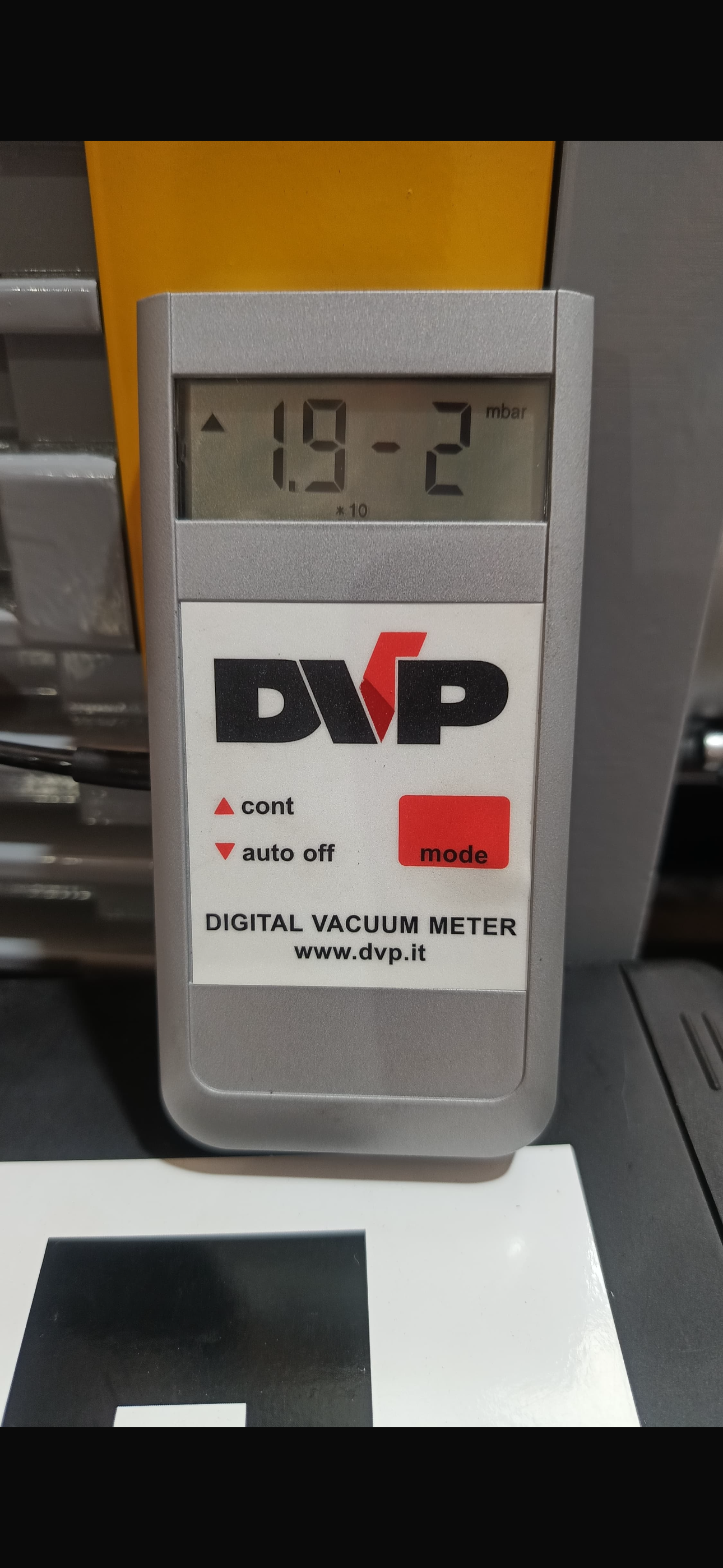
Field measurement showing approximately 0.019 mbar (about 1.9 Pa). This is an observation from this specific test, not a universal performance value for the pump series.
Oil Mist and Low Vacuum Are Two Symptoms, Not One Diagnosis
Visible exhaust oil mist does not automatically prove that a rotary vane pump is mechanically damaged. Oil-sealed rotary vane pumps can discharge oil aerosol, and the amount can become much more noticeable when gas throughput is high—for example during roughing from atmospheric pressure, when a system has a continuous gas inflow, or when gas ballast is being used. Edwards specifically identifies high gas throughput and gas-ballast operation as conditions that increase exhaust oil mist. [1]
Poor vacuum also does not automatically prove an internal pump failure. Leybold's general troubleshooting guidance recommends separating the vessel from the pumping system and first checking whether the pumping system alone can reach its expected pressure. If it can, attention shifts toward the chamber, pipework, seals, contamination, or measurement system. [3]
The practical point is simple: do not use the presence of oil mist as proof of the cause of poor vacuum, and do not use a poor vacuum reading as proof that the pump needs overhaul. Diagnose the two symptoms systematically.
Step 1 — Separate the Pump From the Vacuum System
The first diagnostic split is between a pump-side problem and a system-side problem. If the application permits a manufacturer-approved blank-off test, isolate the pump inlet from the process and use a short, clean, leak-tight test connection with a suitable gauge. Never block the exhaust; keep the outlet connected to the approved discharge or exhaust-treatment arrangement.
If the pump reaches an acceptable blank-off pressure but the chamber does not, the next investigation should focus on the vacuum system: flange seals, hoses, valves, threaded fittings, chamber leakage, outgassing, vapor generation, and restrictive piping. Leybold recommends this pump-versus-system separation as an early troubleshooting step. [3]
If the pump still cannot reach the expected pressure when tested independently under agreed conditions, the investigation moves toward the gauge, oil condition, gas ballast, operating temperature, exhaust condition, and internal pump components.
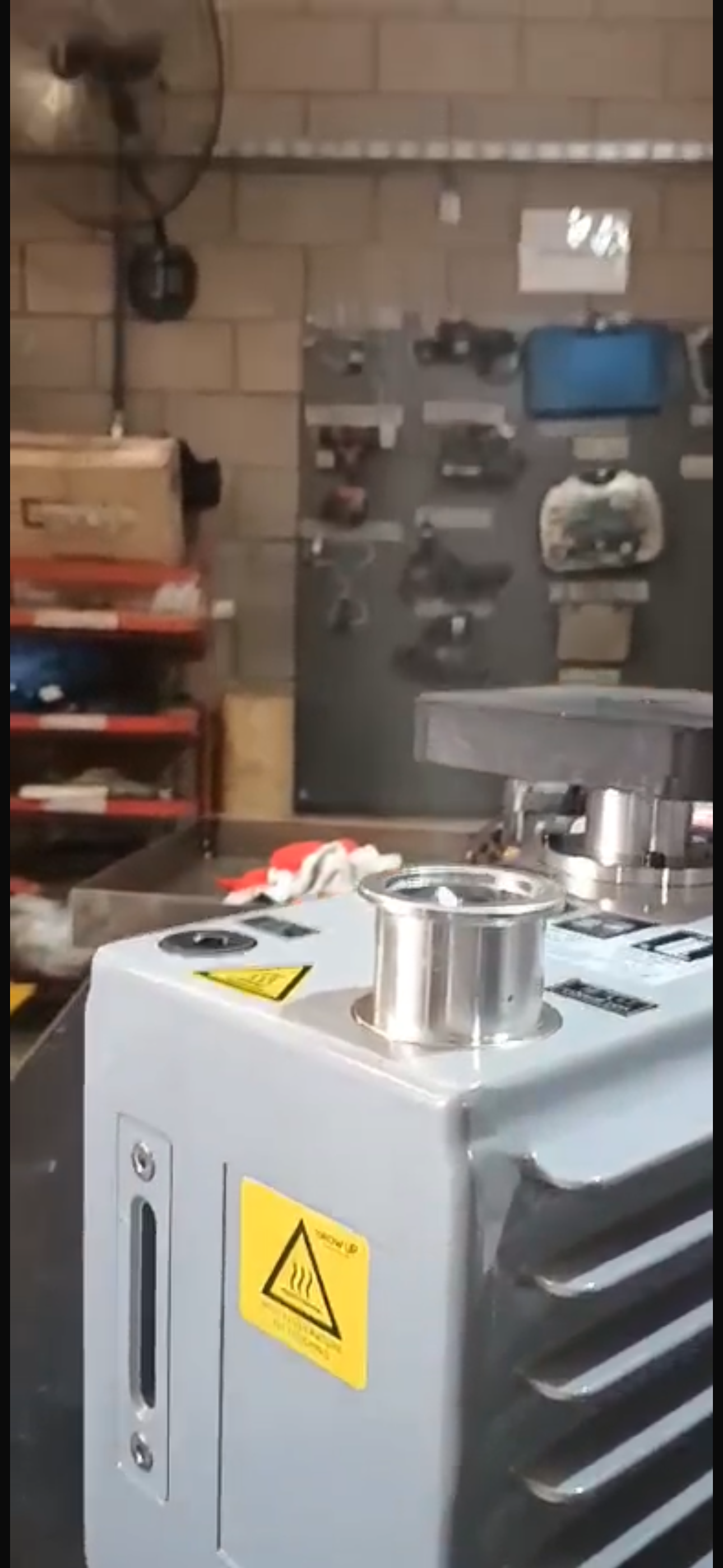
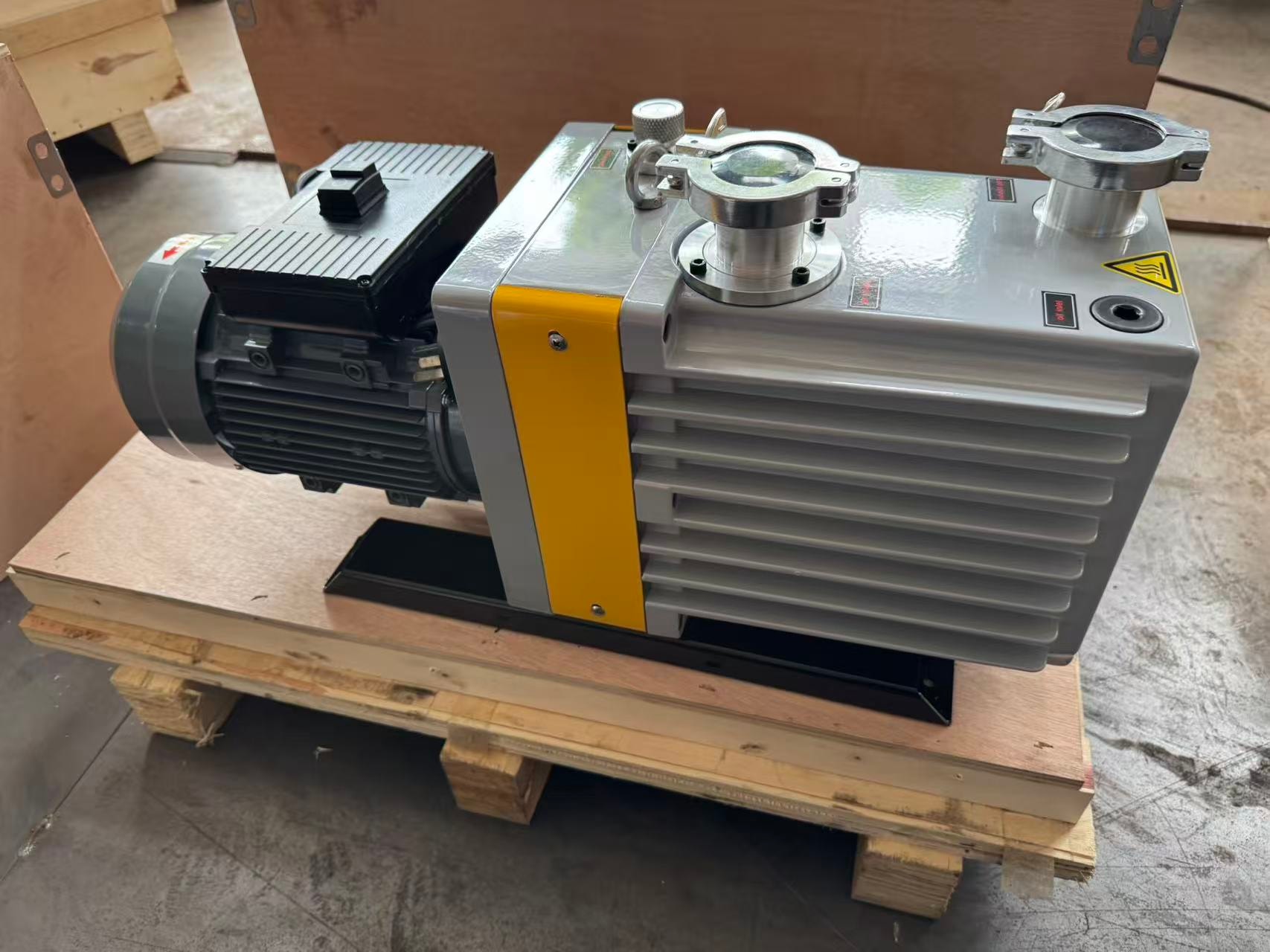
Pump used during the field evaluation. Test configuration, sealing method, measurement location and operating conditions should be recorded before comparing the result with a catalog ultimate-pressure figure.
Step 2 — Verify the Gauge and the Measurement Basis
Before rejecting the pump, confirm what the instrument is actually measuring and whether it is suitable at the target pressure. Record the gauge model, measurement range, units, calibration basis, measurement location, and whether the reading is stable or still falling.
A catalog ultimate-pressure figure and a field gauge reading are meaningful only when the pressure definition and test conditions are comparable. Gauge technology, gas composition, measurement location, oil condition, gas-ballast state, and stabilization all matter. A previous ZT Pumps guide explains this measurement issue in detail: Rotary Vane Pump Ultimate Vacuum: 0.06 Pa vs 0.5 Pa.
For troubleshooting, keep the original data. A trend of pressure versus time is more useful than a single photograph because it shows whether the pump is stabilizing, improving, or stalled.
Step 3 — Check the Test Sealing and Vacuum Connections
The March field evaluation used workshop rubber sealing material during part of the test. That does not prove that a leak was present, but it means leak tightness has to remain an open question until it is verified with a proper vacuum connection.
Inspect O-rings, centering rings, blank flanges, clamps, threaded adapters, gauge fittings, valves, hoses, and the chamber itself. Small scratches or damaged sealing surfaces can matter at low pressure. Leybold specifically notes flange seals as common leak locations and recommends leak and contamination checks when the pump itself reaches ultimate pressure but the system does not. [3]
Use the shortest practical test assembly. Long or narrow lines add conductance loss and can make a chamber reading higher than the pressure available directly at the pump inlet.
Step 4 — Check Oil Level, Oil Condition and Oil Grade
Oil is part of the sealing, lubrication, cooling, and gas-handling mechanism in an oil-sealed rotary vane pump. A correct level is necessary, but a correct level does not prove that the oil is dry, clean, chemically suitable, or still capable of supporting low-pressure performance.
Look for discoloration, cloudiness, unusual odor, water contamination, solvent contamination, degraded oil, or the wrong oil grade. Leybold identifies contaminated oil—especially oil containing dissolved vapors—as a common reason a rotary vane pump fails to achieve its required ultimate pressure. [4]
ZT Pumps' 2XZ operating instructions likewise list insufficient or contaminated oil, external leakage, exhaust-valve problems, oil-circuit blockage, excessive oil temperature, and worn vanes or vane springs among possible causes of inadequate vacuum. The same instructions list excessive oil quantity or an oil level that is too high as a possible cause of oil discharge/spray. These are model-family troubleshooting notes, not proof that any one of those faults caused the March field result. [6]
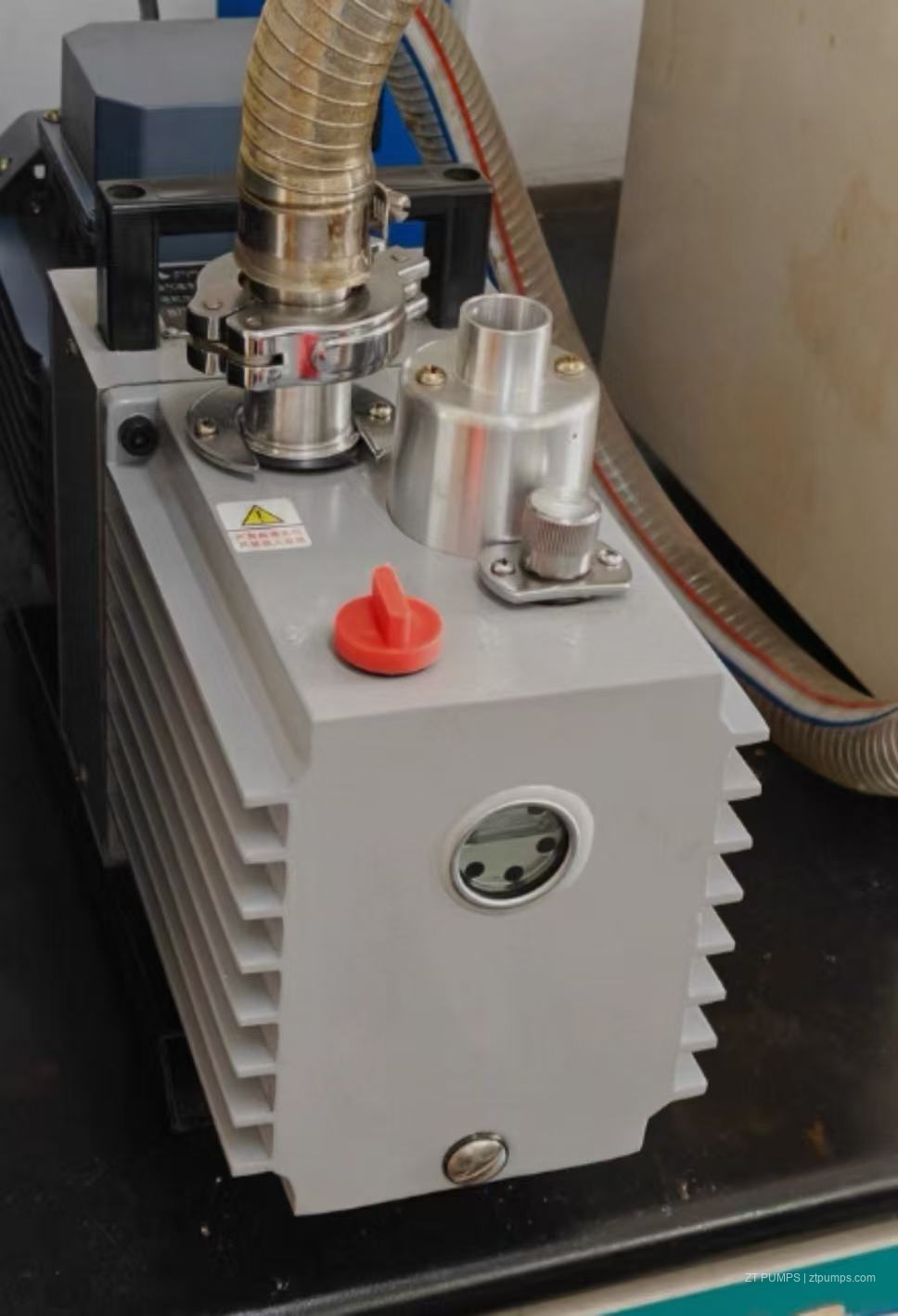
The sight glass confirms oil level, but not whether the oil is dry, uncontaminated or still suitable for low-pressure operation.
Step 5 — Check the Gas Ballast Position and Vapor Load
Gas ballast is intended to help oil-sealed pumps handle condensable vapor by reducing condensation inside the pump. That makes it useful in wet duties, but it also changes the operating condition. Manufacturer instructions for many oil-sealed rotary vane pumps specify gas ballast closed when the goal is the lowest dry-gas ultimate pressure, while gas ballast is opened for vapor handling or oil decontamination. Always follow the exact pump manual. [2]
If water or solvent vapor has condensed in the oil, recovery to ultimate pressure can take much longer. Edwards notes that condensed water can degrade rotary vane pump oil and that gas ballast can be used to condition the pump after exposure to condensables. [2]
This is why a dry blank-off test and a wet production process are not equivalent. If the process continuously releases vapor, evaluate whether the pump needs longer conditioning, an inlet separator, a condenser, different operating settings, or a different vacuum technology.
Step 6 — Understand Why Oil Mist May Be Heavy
Oil mist is a fine aerosol of pump oil carried with the exhaust gas. It becomes more visible when the pump is moving a large volume of gas. Edwards notes that roughing a large chamber, pumping a high continuous gas flow, and operating with gas ballast can all increase exhaust mist. [1]
That observation creates an important troubleshooting clue. If the pump continues to discharge a large amount of gas long after it should have reached low pressure, ask why gas is still entering the pump. A system leak, an open inlet path, a process gas load, or an open gas ballast may be keeping gas throughput high. The oil mist is then a symptom of the operating condition, not necessarily the root cause.
An exhaust mist filter can improve the working environment by capturing oil aerosol. However, it is not a substitute for fixing a leak, correcting an unsuitable duty, or restoring contaminated oil. Use a filter or exhaust-treatment arrangement approved for the pump and do not create excessive exhaust restriction.
Step 7 — If the Pump Still Performs Poorly, Investigate the Pump Itself
Internal inspection becomes more reasonable after the measurement, sealing, oil, gas ballast, temperature, and process load have been checked. If a properly prepared pump still fails a defined blank-off acceptance test, then the pump itself may need service.
Depending on the model, possible internal causes can include an exhaust-valve problem, blocked oil passages, worn vanes, damaged vane springs, seal deterioration, internal contamination, or mechanical wear. ZT Pumps' 2XZ instructions list several of these items under inadequate-vacuum troubleshooting. [6]
Avoid changing multiple variables at once. If the gauge is replaced, oil is changed, seals are reworked, and the pump is disassembled in the same step, it becomes difficult to identify what actually corrected the problem.
Quick Troubleshooting Table
| What you see | Possible explanation | Check first |
|---|---|---|
| High pressure + heavy oil mist | High continuous gas flow, leak, open gas ballast, or unsuitable operating condition | Perform an approved pump-inlet blank-off test and confirm gas ballast |
| Good pump-only vacuum, poor chamber vacuum | System leak, vapor/outgassing, restrictive piping, or process load | Check chamber, seals, valves, hoses and piping |
| Vacuum improves after oil service | Oil contamination may have contributed | Review oil grade, condition and process vapor |
| Vacuum worsens with gas ballast open | Different operating condition; added ballast gas | Record ballast state and compare on the correct basis |
| Stable reading remains above catalog figure | Test basis, gauge, gas composition, oil or pump condition may differ | Verify measurement basis before rejecting the pump |
| Poor blank-off vacuum after external checks | Possible pump-side fault | Follow model-specific troubleshooting and service procedure |
A Practical Test Sequence
A useful troubleshooting sequence is to document the pump model and gauge first, then inspect the oil, confirm the gas-ballast setting, warm and stabilize the pump according to its instructions, perform an approved pump-inlet blank-off test, and finally compare pump-only performance with complete-system performance.
Only after these steps should disassembly become the next troubleshooting action. This sequence reduces the risk of overhauling a healthy pump when the actual problem is a leak, measurement issue, contaminated oil, vapor load, or operating condition.
When Should You Add an Exhaust Mist Filter?
An exhaust mist filter is worth considering when visible oil aerosol is unacceptable in the work area or exhaust duct, particularly in applications with significant gas throughput. Edwards recommends exhaust mist filtration for oil-sealed rotary vane pumps where oil mist needs to be controlled. [1]
But the filter should be treated as exhaust treatment, not as a cure for poor vacuum. If oil mist suddenly becomes much heavier than normal, first check the gas load, gas-ballast state, oil level, oil condition, and whether the pump is operating at the expected inlet pressure.
Frequently Asked Questions
Does 0.019 mbar mean the pump is defective?
No. In the March field case, 0.019 mbar (about 1.9 Pa) was an observed result, not a diagnosis. The gauge, sealing, test conditions, oil, gas ballast and pump condition still had to be separated before assigning a root cause.
Does visible oil mist mean the pump is broken?
Not necessarily. Oil mist can increase with high gas throughput, roughing from atmosphere or gas-ballast operation. Persistent or unusually heavy mist still deserves investigation of gas load, oil level, oil condition and exhaust treatment. [1]
Will an exhaust mist filter improve ultimate vacuum?
Its primary job is to capture exhaust oil aerosol. It should not be used as a substitute for fixing leaks, contaminated oil, an unsuitable test method or a pump fault. Use the approved filter and exhaust arrangement for the pump.
Should gas ballast be open during an ultimate-pressure test?
Follow the exact manufacturer procedure. For many oil-sealed rotary vane pumps, the lowest dry-gas ultimate pressure is checked with gas ballast closed, while gas ballast is used for condensable-vapor handling and oil conditioning. [2]
What if the pump reaches good vacuum when blanked off but the chamber does not?
That result shifts the investigation toward the system side: leakage, outgassing, vapor load, restrictive piping, valves, hoses or the measurement location. [3]
Do Not Replace the Pump Until You Know What You Are Fixing
Oil mist and a higher-than-expected vacuum reading can appear together, but they do not automatically identify the same root cause. A healthy pump can be attached to a leaking system. A suitable pump can be tested with an unsuitable gauge. Correct oil level can coexist with contaminated oil. Gas ballast can be useful for vapor handling while making a low-pressure comparison invalid if its state is not recorded.
The most efficient troubleshooting method is to separate measurement, system, and pump conditions in a controlled sequence. Once those variables are separated, the next action—measurement verification, leak checking, oil service, exhaust treatment, or pump repair—becomes much clearer.
Need Help Diagnosing a Rotary Vane Vacuum Pump?
Send ZT Pumps the pump model and nameplate, current vacuum reading, vacuum-gauge model, oil condition, gas-ballast position, inlet and exhaust photographs, process gas or vapor information, duty cycle, and a short operating video. We can help determine whether the next step should focus on measurement, the vacuum system, oil and vapor management, exhaust treatment, or pump inspection.
Contact ZT Pumps for a troubleshooting review
Related ZT Pumps Resources
For pressure-definition and gauge questions, read Rotary Vane Pump Ultimate Vacuum: 0.06 Pa vs 0.5 Pa.
For product selection and current rotary-vane families, see ZT Pumps rotary vane vacuum pumps.
For technical support or a troubleshooting review, use the ZT Pumps contact form.
Technical References
[1] Edwards Vacuum — Exhaust Mist Filters for Oil Sealed Rotary Vane Pumps — https://www.edwardsvacuum.com/content/dam/brands/edwards-vacuum/general-vacuum/gated-downloads/application-notes/3601-2047-01-exhaust-mist-filters.pdf
[2] Edwards Vacuum — Why Gas Ballast Is Important on Oil-Sealed Rotary Vane Pumps — https://www.edwardsvacuum.com/en-us/vacuum-pumps/knowledge/applications/why-gas-ballast-is-important-on-oil-sealed-rotary-vane-pumps
[3] Leybold — Vacuum Pump Maintenance: General Troubleshooting — https://www.leybold.com/en-us/knowledge/vacuum-fundamentals/vacuum-maintenance/general-troubleshooting
[4] Leybold — Rotary Vane Vacuum Pump Maintenance and Oil Change — https://www.leybold.com/en-uk/knowledge/vacuum-fundamentals/vacuum-maintenance/oil-change-for-rotary-vane-vacuum-pumps
[5] Leybold — How Does an Oil-Sealed Rotary Displacement Pump Work? — https://www.leybold.com/en-us/knowledge/vacuum-fundamentals/vacuum-generation/how-does-an-oil-sealed-rotary-displacement-pump-work
[6] ZT Pumps — 2XZ Series Operating Instructions (first-party technical manual)
Explore Topics
Written by
Zhongtian Pumps Engineering Team
The Zhongtian Pumps Engineering Team specializes in industrial vacuum pump manufacturing, application engineering and vacuum system design. Nantong Zhongtian Machinery Manufacturing Co., Ltd. has manufactured industrial vacuum equipment since 2002.