Why Does a Rotary Vane Vacuum Pump Rated at 0.06 Pa Read 0.5 Pa on a Pirani Gauge?
Why does a 0.06 Pa rotary vane pump show 0.5 Pa on a Pirani gauge? Understand pressure definitions, gauge limits and practical pump-inlet testing.
A rotary vane vacuum pump datasheet lists an ultimate pressure of 0.06 Pa. During a pump-inlet check, a Pirani gauge indicates 0.5 Pa. Does the higher reading mean the pump is defective?
Not necessarily. But the difference alone does not prove that the pump is operating correctly, either. Before comparing the numbers, establish the pressure definition, measurement method and test conditions. A non-condensable-gas pressure specification and a gas-dependent Pirani indication are not automatically equivalent measurements. [1–4]
This guide explains how to interpret rotary vane vacuum pump ultimate vacuum specifications, investigate a higher-than-expected reading, and agree a meaningful acceptance test.
The 0.06 Pa and 0.5 Pa figures are an illustrative comparison, not a guaranteed relationship between two instruments or a universal specification for two-stage pumps. All pressure values below are absolute unless stated otherwise.
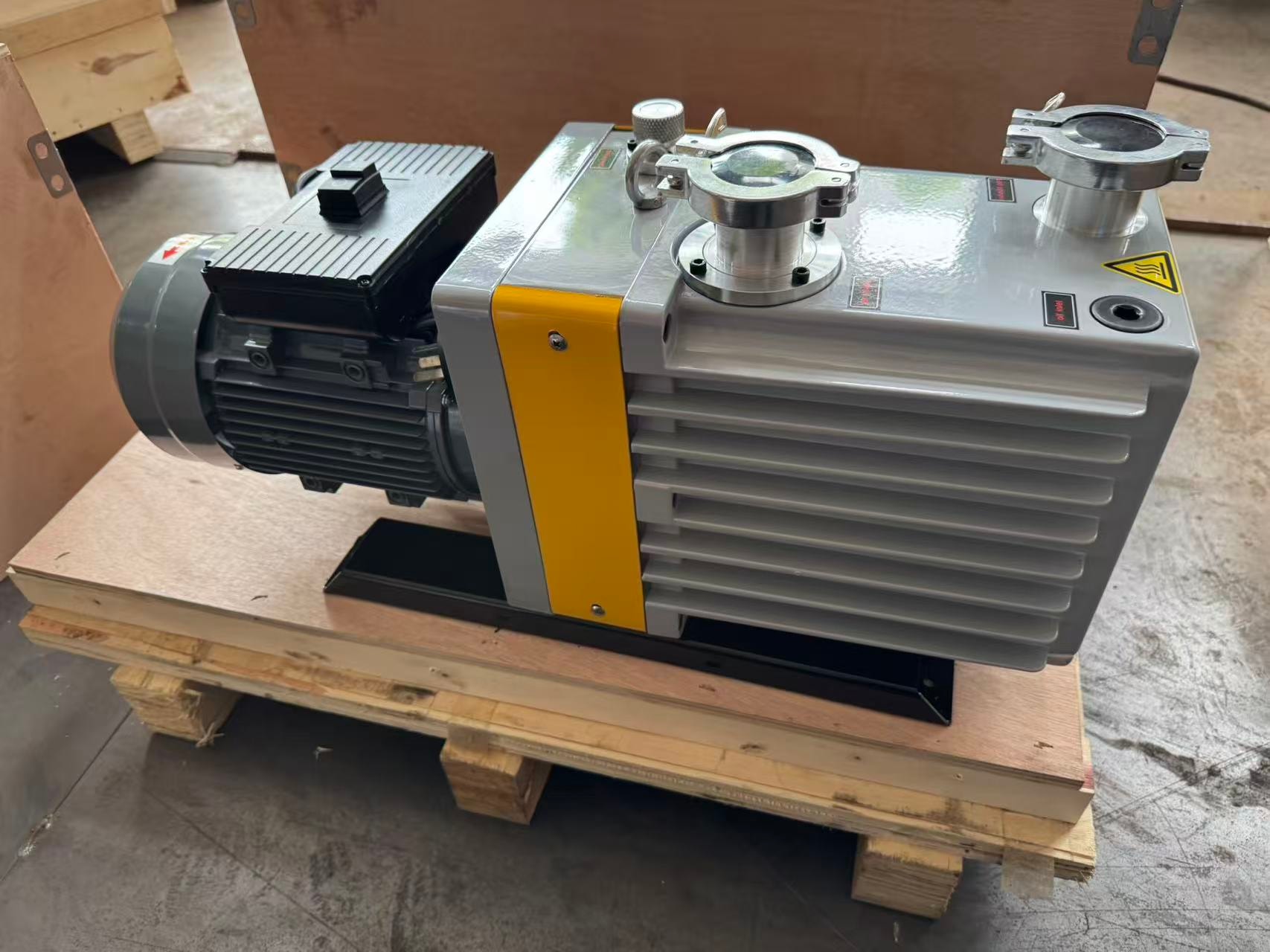
Two-stage oil-sealed rotary vane vacuum pump. Ultimate pressure should be evaluated together with the specified measurement method and test conditions.
What Does "Ultimate Vacuum" Actually Mean?
A pump's rated ultimate pressure describes its limiting low-pressure performance under specified test conditions. A practical blank-off check isolates the inlet from the process, connects a small test manifold and gauge, and allows the pump and measurement to stabilize. It does not demonstrate the pressure that a production chamber will maintain while continuously releasing gas or vapor. [2]
The useful question is therefore not simply "What vacuum can this pump reach?" It is "What pressure, measured where, with which instrument, and under what load?"
| Pressure being discussed | What it describes | What must be confirmed |
|---|---|---|
| Catalog ultimate pressure | A pump performance specification under a defined test basis | Partial or total pressure, gas-ballast state, oil and test method |
| Pump-inlet gauge reading | The indication at the installed sensor during a particular test | Gauge model, calibration, gas response, installation and stabilization |
| Chamber operating pressure | The pressure at the process while the system is working | Gas load, effective pumping speed, piping and operating conditions |
Application context: A customer enquiry about ZT Pumps' 2X and 2XZ two-stage pumps raised the distinction between a 0.06 Pa catalog figure and approximately 0.6 Pa discussed for inlet Pirani measurement. This article addresses that specification question; it is not a certified acceptance-test report.
Why 0.06 Pa and 0.5 Pa Are Not Automatically Contradictory
Partial Pressure and Total Pressure Are Different Quantities
The total pressure of a gas mixture is the sum of its component partial pressures. In some rotary vane pump specifications, "ultimate partial pressure" refers to the combined contribution of non-condensable gases, rather than the total pressure including condensable vapors. This terminology should be checked against the manufacturer's test documentation. [1]
A figure labeled only "ultimate vacuum" leaves that distinction unresolved. Do not assume that every 0.06 Pa specification was obtained with a McLeod gauge, or that every manufacturer uses the same convention.
A McLeod Gauge Can Under-Represent Condensable Vapors
A McLeod gauge traps a gas sample and compresses it into a smaller volume. The original pressure is calculated from the compression relationship. Vapors that condense during this process do not behave like permanent gases, so their original contribution is not measured correctly. Consequently, a McLeod-based result should not automatically be interpreted as total pressure in a vapor-containing system. [3]
This also does not make the McLeod gauge a gas analyzer: it does not separately identify the individual gases present.
A Pirani Gauge Responds to Gas Properties
A Pirani gauge infers pressure from heat transfer between a heated sensing element and the surrounding gas. Its response depends on gas composition as well as pressure. Air or nitrogen calibration does not make the displayed number an exact, gas-independent total-pressure measurement for every mixture. [4]
This creates two distinct questions. First, are the instruments responding to the same components of the gas mixture? Second, how accurately does each instrument measure under the actual conditions?
There is no universal conversion factor from 0.06 Pa on a McLeod gauge to 0.5 Pa on a Pirani gauge. Nor can the difference simply be assigned to 0.44 Pa of water or oil vapor. The gas composition and instrument response would have to be established.
Both values may be explainable, but the explanation must be verified. A measurement-method difference is not an automatic pass certificate for the pump.
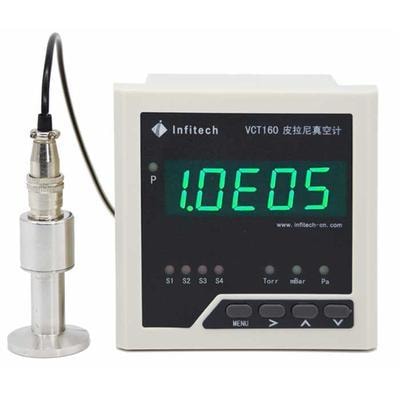
A Pirani gauge determines pressure indirectly from gas-dependent heat transfer. Its reading therefore depends on the sensor characteristics, calibration and gas composition.
McLeod vs Pirani vs Capacitance Diaphragm Gauges
| Gauge type | Measurement basis | Principal limitation in this comparison |
|---|---|---|
| McLeod | Compression of a known gas sample | Condensable vapors can invalidate a total-pressure interpretation |
| Pirani | Gas-dependent heat transfer | Gas composition, sensor condition and low-end accuracy affect the indication |
| Capacitance diaphragm | Mechanical diaphragm deflection | Gas-independent principle, but the selected full-scale range, zero stability and calibration still matter |
The appropriate instrument depends on the measurement task, not simply on which one displays the lowest number. Mercury-based McLeod instruments also require appropriate mercury-handling controls; explaining their role in specifications is not a recommendation to introduce them into routine workshop testing. [3–5,9]
Seven Checks When the Vacuum Reading Is Higher Than Expected
1. Confirm the Specification and Units
Ask whether the stated limit is partial or total pressure and whether gas ballast was open or closed during the reference test. Confirm that both numbers use absolute pressure and the same units.
For example, 0.06 Pa equals 0.0006 mbar, while 0.5 Pa equals 0.005 mbar. Changing the display unit changes neither the physical pressure nor the gauge's measurement capability.
2. Check the Gauge at the Pressure You Need to Verify
Read the sensor-and-controller specifications, not just the screen's decimal places. Measurement range, accuracy, repeatability and resolution are different specifications. A gauge may display values outside the range in which its best accuracy is specified; INFICON's Pirani documentation, for example, explicitly distinguishes these ranges. [5]
A gauge specified only down to 0.1 Pa cannot verify 0.06 Pa or 0.01 Pa. Also check calibration status and sensor contamination. Do not adjust the gauge merely to make it agree with a catalog value. [3,5]
3. Check Oil Grade, Level and Condition
Use the pump manufacturer's specified oil and filling procedure. Water, solvents or degraded oil can change pump performance. An apparently adequate oil level does not establish that the oil remains suitable for a low-pressure test. Follow the maintenance instructions before replacing oil or opening the pump. [7]
4. Separate Vapor Load from an Instrument Effect
Water released from a damp manifold or process chamber is a real gas load. A higher reading is therefore not necessarily "just the gauge." Moisture can affect both the pressure in the system and the condition of the pump oil. Evaluate the pump separately from a wet process before drawing conclusions about its blank-off performance. [6,10]
5. Look for Leaks and Other Gas Sources
Inspect the test connections, seals, valves and unused ports. Leakage, permeation and outgassing can prevent a low, stable pressure. An isolated pressure-rise check can be useful, but a pressure rise alone does not prove an external air leak: internal surfaces and trapped volumes can also release gas. [10]
6. Verify Gas Ballast and Thermal Stabilization
Gas ballast helps carry condensable vapors through the pump rather than allowing them to collect in the oil. It also changes the operating conditions. A gas-ballast-open reading must not be judged against a gas-ballast-closed specification. Use the manufacturer's warm-up and conditioning procedure before taking the final reading. [6,7]
7. Check Where the Pressure Is Measured
A gauge on the chamber and a gauge at the pump inlet need not indicate the same pressure during gas flow. Long or narrow lines, valves and filters limit conductance and reduce the effective pumping speed available to the chamber. A pump-inlet test and a complete-system test answer different questions. [8]
If a correctly performed inlet test still falls outside the agreed acceptance limit, investigate the pump itself. Installation errors, restricted exhaust, worn components or other mechanical faults must not be dismissed as gauge differences. Follow the model-specific service instructions. [7]
How to Perform a Meaningful Pump-Inlet Vacuum Test
The following is a diagnostic framework, not a replacement for a manufacturer's procedure or a contractual test method.
Step 1: Agree the Acceptance Basis
Record the exact pump model, pressure quantity, acceptance limit, gauge model and required accuracy. Specify oil condition, gas-ballast position, stabilization criteria and whether the result is for a blanked inlet or a working process.
"Reach 0.06 Pa" is incomplete without these details. A documented criterion such as "total absolute pressure at the pump inlet, measured by the agreed instrument under the agreed conditions" gives both parties a usable basis for comparison.
Step 2: Use a Minimal, Leak-Tight Test Assembly
Connect a short, clean, vacuum-rated manifold to the inlet. Mount the gauge on that manifold and blank the unused process connection. The sensor must remain connected to the volume being evacuated; do not close a valve that isolates it from the pump.
Blank off the inlet test volume—not the exhaust. Keep the exhaust connected to the manufacturer's approved discharge or exhaust-treatment arrangement. Follow the gauge's installation and orientation requirements.
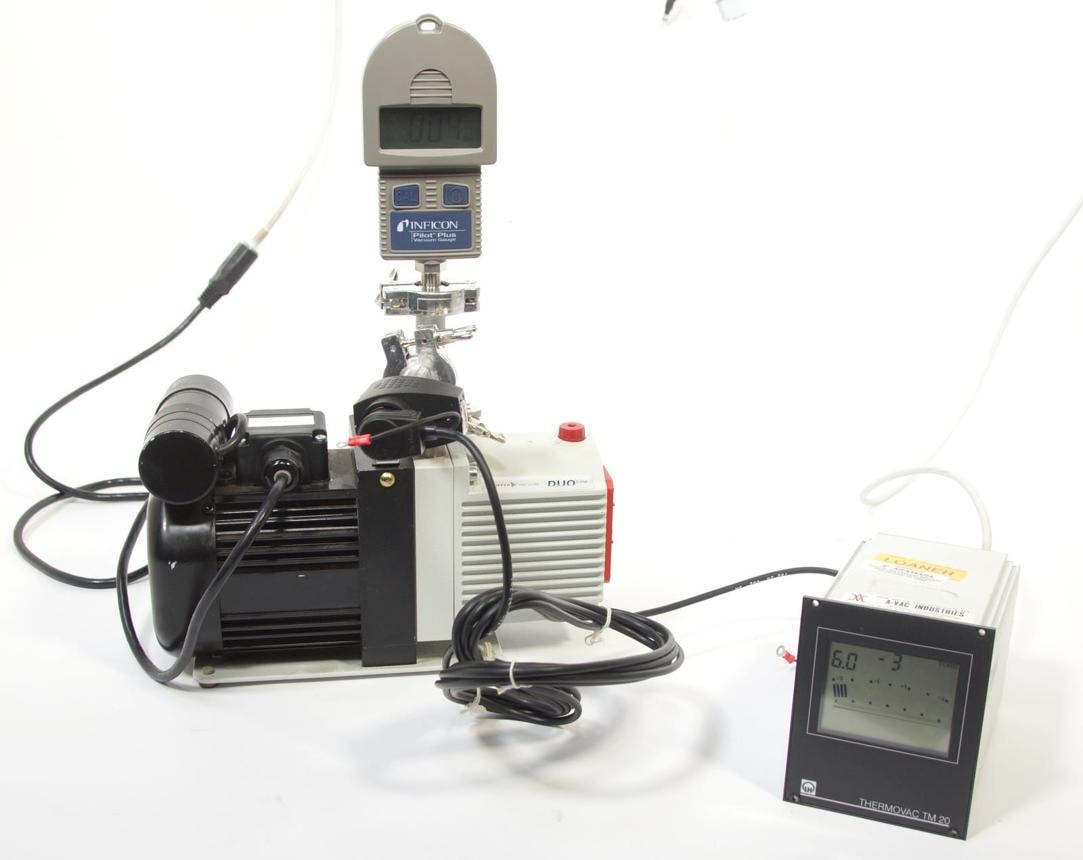
For a meaningful blank-off test, pressure should be measured at or near the pump inlet using a suitable vacuum gauge and a short, leak-tight test connection.
Step 3: Prepare and Stabilize the Pump
Check the specified oil, level, installation and operating settings. Apply the manufacturer's conditioning procedure when moisture is suspected, then establish the gas-ballast state required for the test. Allow the pump and gauge to stabilize rather than relying on an arbitrary universal warm-up time. [7]
Step 4: Record a Trend, Not Just a Photograph
Record pressure against elapsed time, together with the test configuration. A single display photograph cannot establish whether the reading was stable, whether the gauge was suitable, or whether the pump was still warming up.
A useful test record includes the pump and gauge identification, pressure units, oil condition, gas-ballast position, measurement location, stabilization history and final reading. Preserve the original readings rather than rounding them to match the specification.
Step 5: Cross-Check Before Accepting or Rejecting
When the result remains disputed, compare it with a calibrated reference instrument suitable for the pressure and gas composition. Use comparable measurement locations and operating conditions. If the result is close to the acceptance limit, account for measurement uncertainty instead of treating the last displayed digit as definitive.
A confirmed failure under the agreed test conditions requires corrective action. A satisfactory blank-off result, however, still does not prove that a connected process will meet its operating-pressure requirement.
Why Chamber Pressure Can Be Higher Than Pump-Inlet Pressure
A chamber continuously releases gas from its contents, surfaces and connections. The pump must remove this load through the connecting pipework. For a simplified steady-state assessment:
p_chamber ≈ p_base + Q / S_effective
Here, p_base is the relevant baseline pressure, Q is the additional gas throughput and S_effective is the pumping speed available at the chamber. Use consistent units: Pa, Pa·m³/s and m³/s. This is a screening relationship; actual performance depends on gas species and the pressure-dependent pump and piping characteristics. [8,10]
The engineering implication is straightforward: a low catalog ultimate pressure is not enough. The system also needs sufficient pumping speed at the required operating pressure, adequate line conductance and a manageable gas load.
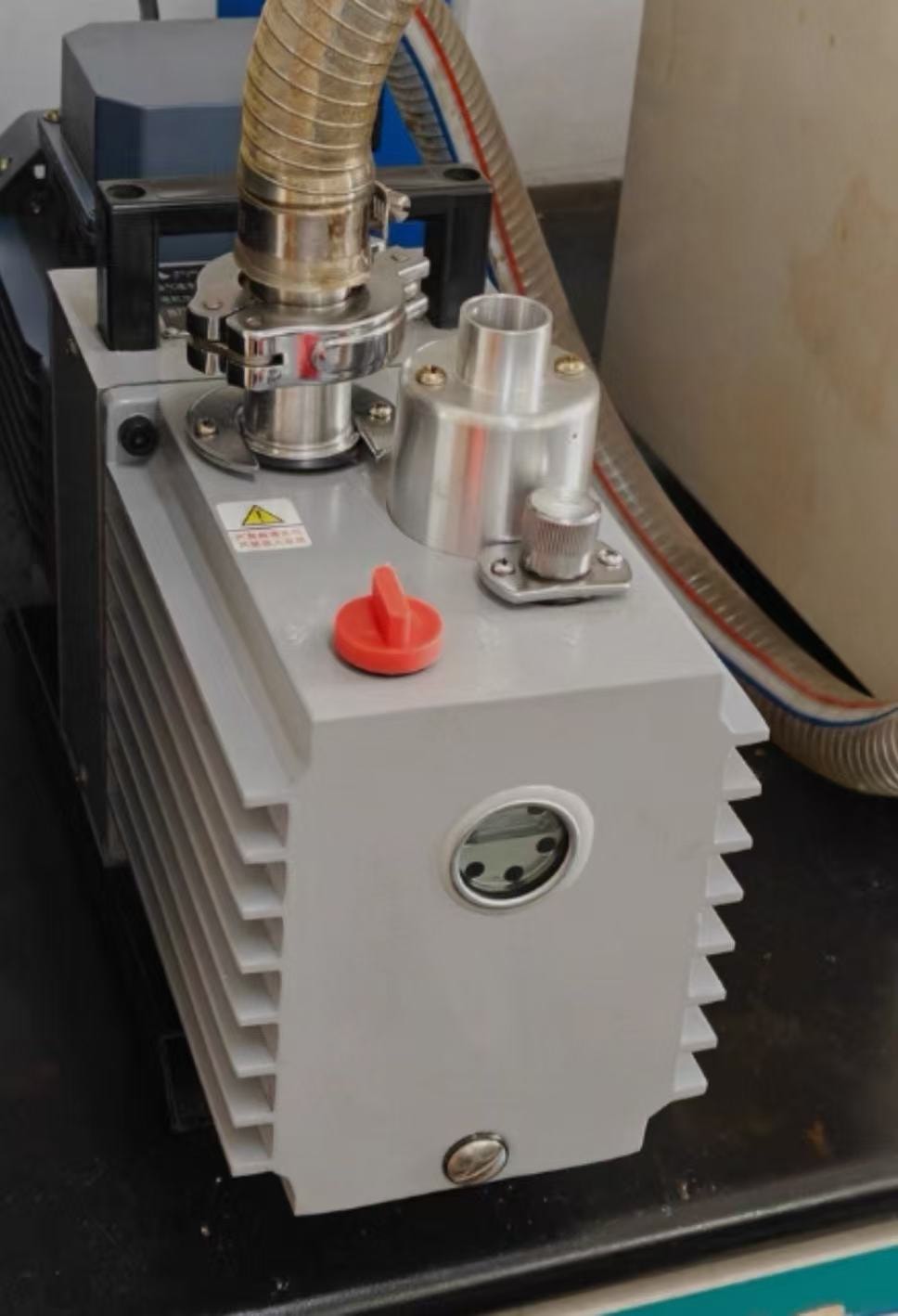
A rotary vane vacuum pump connected to process equipment. System operating pressure can differ from a pump-inlet blank-off measurement because of process gas load and piping conductance.
Which Gauge Should You Use for 0.1 Pa or 0.01 Pa?
Choose the gauge by its documented performance at the target pressure, not by the number of digits on its display.
A suitable Pirani gauge can be useful for pump-down monitoring and sub-pascal checks. However, Pirani designs differ: do not assume that all stop at 0.1 Pa, or that all can accurately verify 0.01 Pa. Check the actual sensor, compatible controller, calibration gas and uncertainty specification. [4,5]
For gas-independent total-pressure measurement, consider a capacitance diaphragm gauge with a suitably low full-scale range. Zero drift, temperature stability and usable resolution must be small enough relative to the target pressure. A high-range diaphragm gauge is not automatically appropriate for a sub-pascal acceptance test. [9]
A suitably specified ionization gauge or Pirani/ionization combination may cover lower pressures, but ionization readings remain gas-dependent. Switching limits, contamination tolerance and operating restrictions must also be respected. Changing technology does not eliminate the need for calibration and an agreed test method. [3]
What Should You Specify When Selecting a 2XZ Pump?
For a 2XZ or 2X two-stage rotary vane pump, request a model-specific performance statement rather than treating either 0.06 Pa or 0.5–0.6 Pa as a universal figure.
Separate the no-load acceptance requirement from the process requirement. For the latter, provide the chamber volume, target pressure, pump-down time, continuous gas or vapor load, temperature and piping arrangement. Ask for pumping performance at the intended operating pressure—not only nominal capacity.
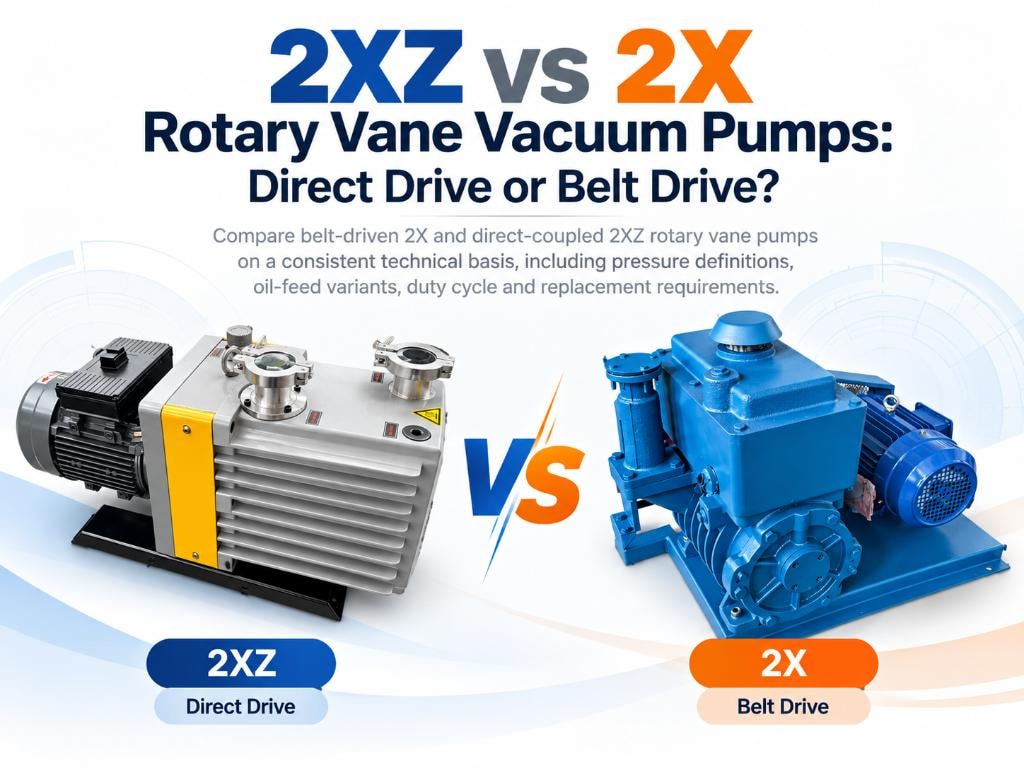
ZT Pumps' two-stage rotary vane vacuum pumps include direct-coupled 2XZ and belt-driven 2X configurations. Compare them on the same measurement basis; a lower number obtained by a different method is not evidence that one drive arrangement produces a deeper usable vacuum.
Where additional pumping speed is needed, engineered Roots booster systems may be evaluated with a suitable backing pump and combined performance data. A booster is not a substitute for resolving leaks, oil contamination or unsuitable measurement equipment.
Frequently Asked Questions
Does a 0.5 Pa Pirani Reading Prove That a 0.06 Pa Pump Is Defective?
No. First verify the specification's meaning, the gauge's suitability and the test conditions. Equally, do not assume the pump is acceptable merely because two gauge types use different principles.
Does a Pirani Gauge Measure Total Pressure?
It provides a gas-dependent pressure indication rather than separate gas-species readings. It should not be treated as an exact, gas-independent total-pressure measurement for an unknown mixture. [4]
Can I Multiply a McLeod Reading by a Fixed Factor to Predict a Pirani Reading?
No universal factor applies. Condensable content, gas composition, instrument design, calibration and operating conditions all matter. The example numbers in this article are not a conversion rule.
Can a Gauge Rated Down to 0.1 Pa Verify 0.01 Pa?
No. That target lies below its stated measurement range. Switching from Pa to mbar or Torr does not extend the range; a different, suitably specified measurement solution is required.
Does a Bigger Pump Automatically Solve the Problem?
No. Extra capacity does not automatically correct a misleading measurement, contamination or a leak. Evaluate gas load and effective pumping speed after establishing a reliable measurement basis. [8,10]
Specify the Measurement Before Comparing the Number
The useful conclusion is not that a 0.06 Pa specification and a 0.5 Pa reading are "the same." It is that they may represent different measurement conditions or pressure quantities—and the cause must be established before judging performance.
Compare like with like: the same pressure definition, suitable instrumentation, a documented test configuration and a clear acceptance criterion.
Need Help Reviewing a Pump or Vacuum Reading?
Send ZT Pumps the pump model, required operating pressure, current reading, gauge model and measuring range, gas or vapor composition, oil condition, gas-ballast setting and a photograph of the inlet or piping arrangement. Include chamber volume and pump-down requirements when selecting a new system.
Request a technical pump review to evaluate the measurement basis and identify an appropriate pump or system configuration for your application.
Technical References
[1] Leybold — How is vacuum pressure measured?
https://www.leybold.com/en/knowledge/vacuum-fundamentals/fundamental-physics-of-vacuum/units-and-ranges-of-pressure
[2] Kurt J. Lesker Company — Pumping Speed
https://www.lesker.com/newweb/technical_info/vacuumtech/pumps_06_pumpingspeed.cfm
[3] Kurt J. Lesker Company — Pressure Measurement Technical Notes
https://www.lesker.com/newweb/gauges/gauges_technicalnotes_1.cfm
[4] Leybold — How does indirect pressure measurement work?
https://www.leybold.com/en-uk/knowledge/vacuum-fundamentals/vacuum-measurement/how-indirect-pressure-measurement-works
[5] INFICON — PSG010, PSG017 & PSG018: technical specifications
https://www.inficon.com/en/products/vacuum-gauge-and-controller/psg01x
[6] Edwards — The principle and application of gas ballast
https://www.edwardsvacuum.com/en-us/vacuum-pumps/knowledge/applications/the-principle-and-application-of-gas-ballast
[7] Edwards — 8 top tips for working with oil-sealed rotary vane pumps
https://www.edwardsvacuum.com/en-us/vacuum-pumps/knowledge/applications/working-with-oil-sealed-rotary-vane-pumps
[8] Leybold — How to calculate vacuum conductance
https://www.leybold.com/en-uk/knowledge/vacuum-fundamentals/fundamental-physics-of-vacuum/how-to-calculate-vacuum-conductance
[9] MKS — DA03B heated capacitance manometer: measurement principle and specifications
https://www.mks.com/f/da03b-heated-ethercat-manometer
[10] Vacuum Technology Considerations for Mass Metrology — research article
https://pmc.ncbi.nlm.nih.gov/articles/PMC4550329/
Explore Topics
Written by
Zhongtian Pumps Engineering Team
The Zhongtian Pumps Engineering Team specializes in industrial vacuum pump manufacturing, application engineering and vacuum system design. Nantong Zhongtian Machinery Manufacturing Co., Ltd. has manufactured industrial vacuum equipment since 2002.