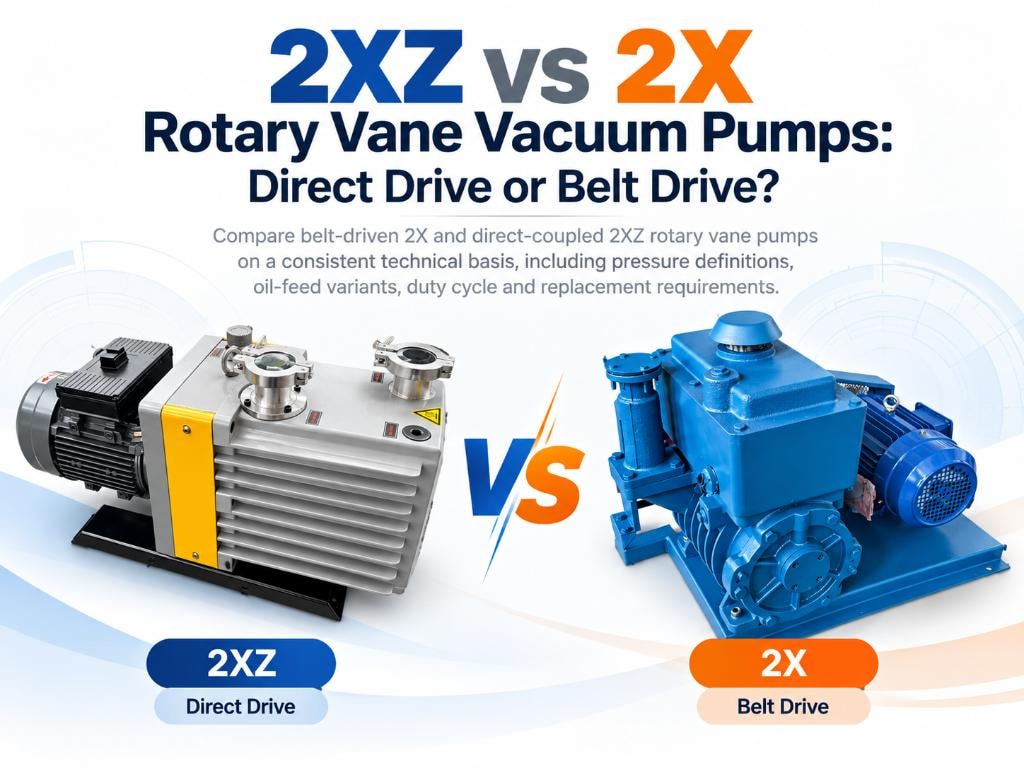
2XZ vs 2X Rotary Vane Vacuum Pumps: Direct Drive or Belt Drive?
Compare belt-driven 2X and direct-coupled 2XZ rotary vane pumps on a consistent technical basis, including pressure definitions, oil-feed variants, duty cycle and replacement requirements.
When comparing two-stage rotary vane vacuum pumps, buyers often focus on the lowest pressure in the catalog. But a useful 2XZ vs 2X comparison also needs to answer practical questions: Will the pump fit the machine? Can it handle the operating cycle? What maintenance will it require?
For the conventional configurations compared here, 2X uses a belt drive and 2XZ uses a direct-coupled drive. The transmission arrangement changes the mechanical layout; it does not, by itself, determine which pump will deliver the better vacuum for your process.
A direct-drive layout can be attractive for compact equipment integration. A belt-driven model may remain a suitable choice for an existing installation and maintenance team familiar with that arrangement. Final selection requires model-specific performance, installation and operating data—not the series name alone.
This guide compares these configurations rather than every pump sold under similar model names. All vacuum pressure values are absolute unless stated otherwise.
What Is the Main Difference Between 2X and 2XZ Pumps?
Both configurations discussed here are oil-sealed, two-stage rotary vane pumps. Rotating vanes form changing working volumes that draw in, compress and discharge gas. The two pumping stages work in series. In an oil-sealed design, the oil contributes to sealing, lubrication and cooling. Two stages do not mean two motors. [1,3]
The key mechanical difference is how motor power reaches the pump shaft.
2X: Belt-Driven Construction
The conventional belt-driven 2X arrangement transmits rotation from the motor through pulleys and a belt to the pump shaft.
Mechanical drive path: Motor → motor pulley → belt → pump pulley → pump shaft.
The pulley ratio establishes the relationship between motor speed and pump speed. This arrangement introduces belt condition, tension, pulley alignment and guard clearance into the maintenance and installation plan. Belt-drive pump manuals specifically address these service requirements. [2]
A pulley is not a user-adjustable shortcut to more pumping capacity. Retain the approved drive configuration unless the manufacturer has evaluated the proposed change.
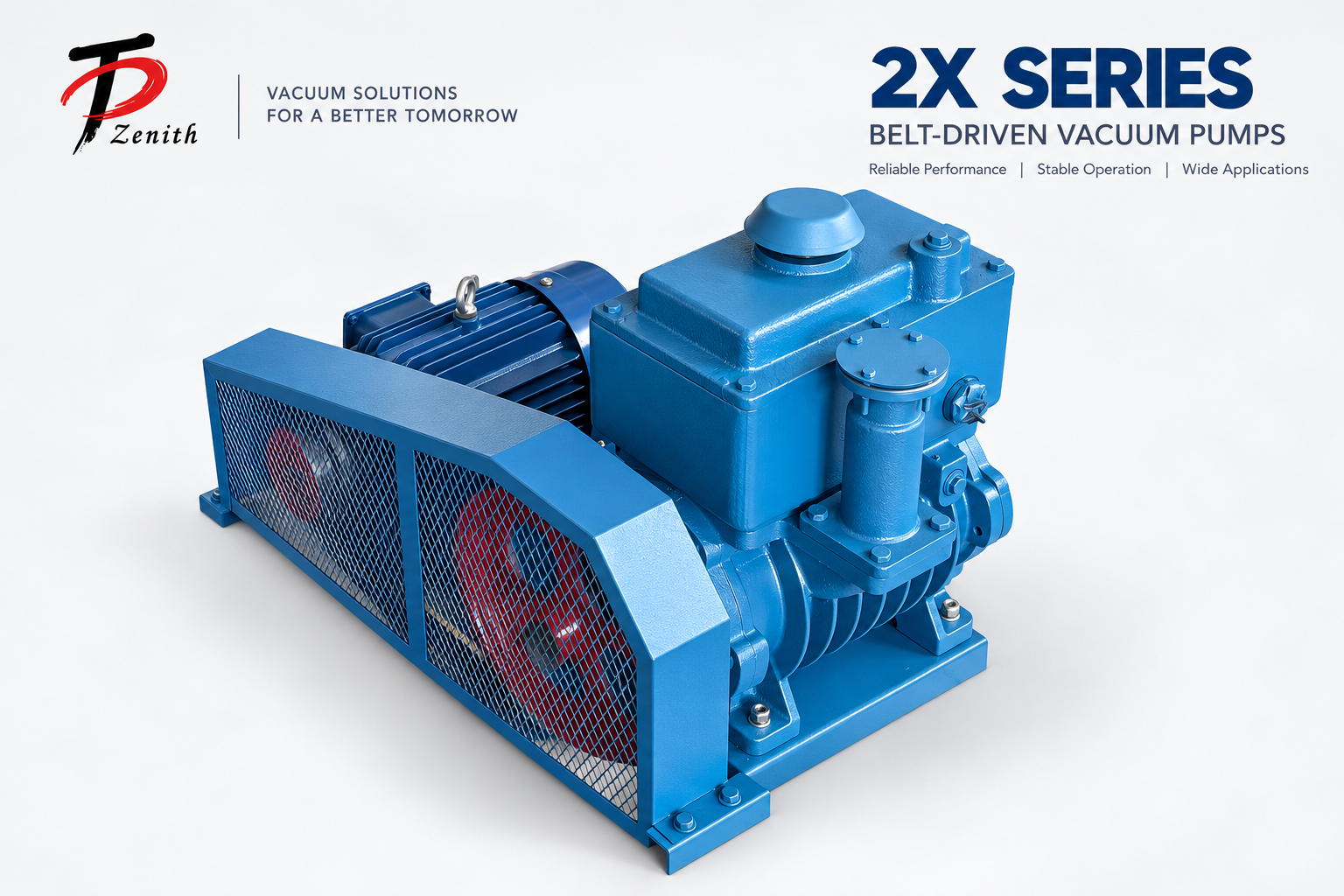
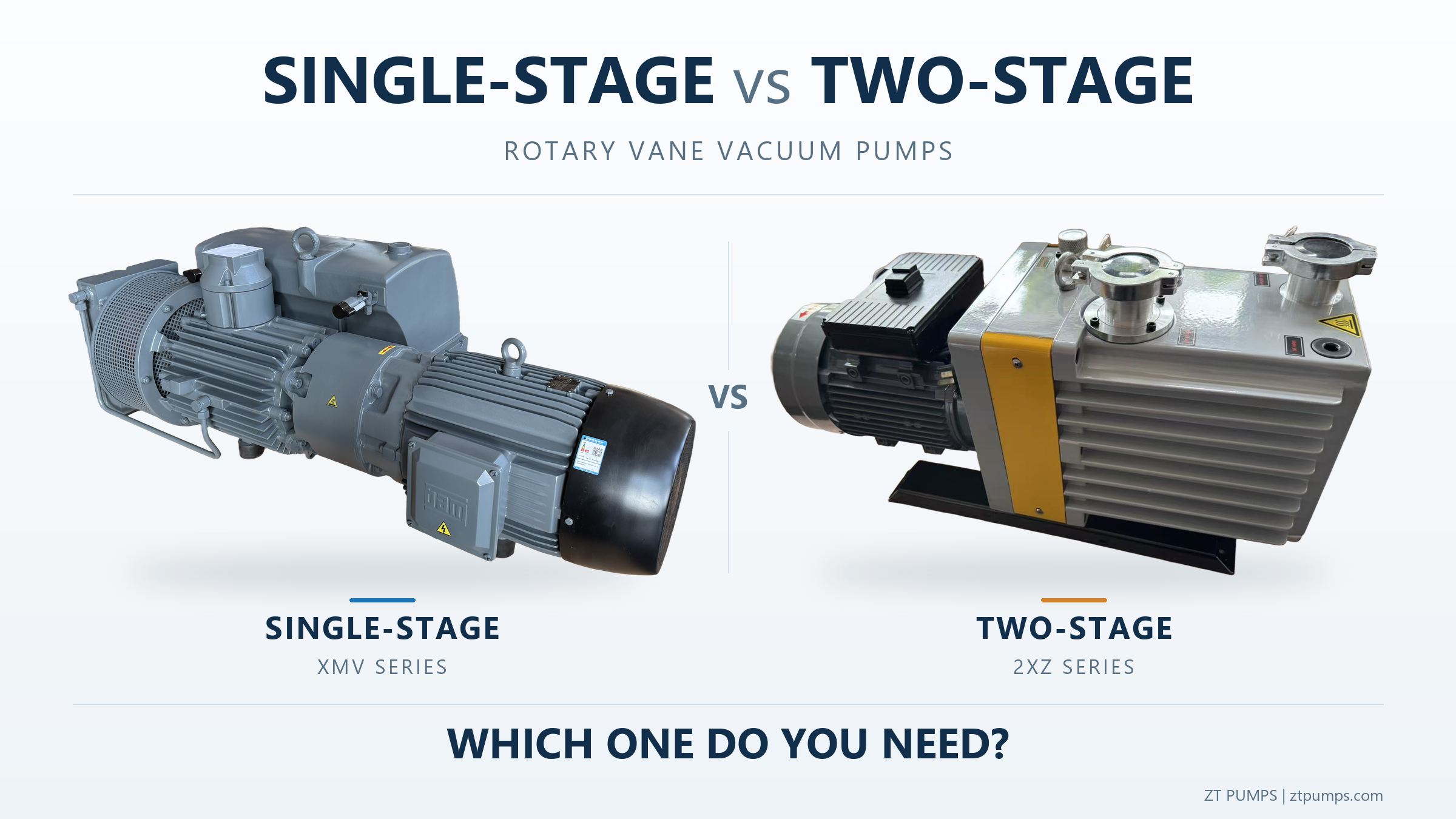
A conventional 2X two-stage rotary vane vacuum pump using a belt-driven transmission between the motor and pump.
2XZ: Direct-Coupled Construction
The 2XZ design connects the motor to the pumping mechanism without an external drive belt. Zhongtian's 2XZ instructions identify a coupling between the motor and pump assembly. [1]
Mechanical drive path: Motor → coupling → pump shaft.
Direct coupling removes belt tensioning from the service plan, but it does not mean that the motor and pump must share one continuous shaft, or that the pump has no transmission components to maintain.
For equipment builders, the close-coupled layout is worth evaluating where space is restricted. Compare actual dimensional drawings and service clearances rather than assuming every 2XZ is smaller than every 2X.
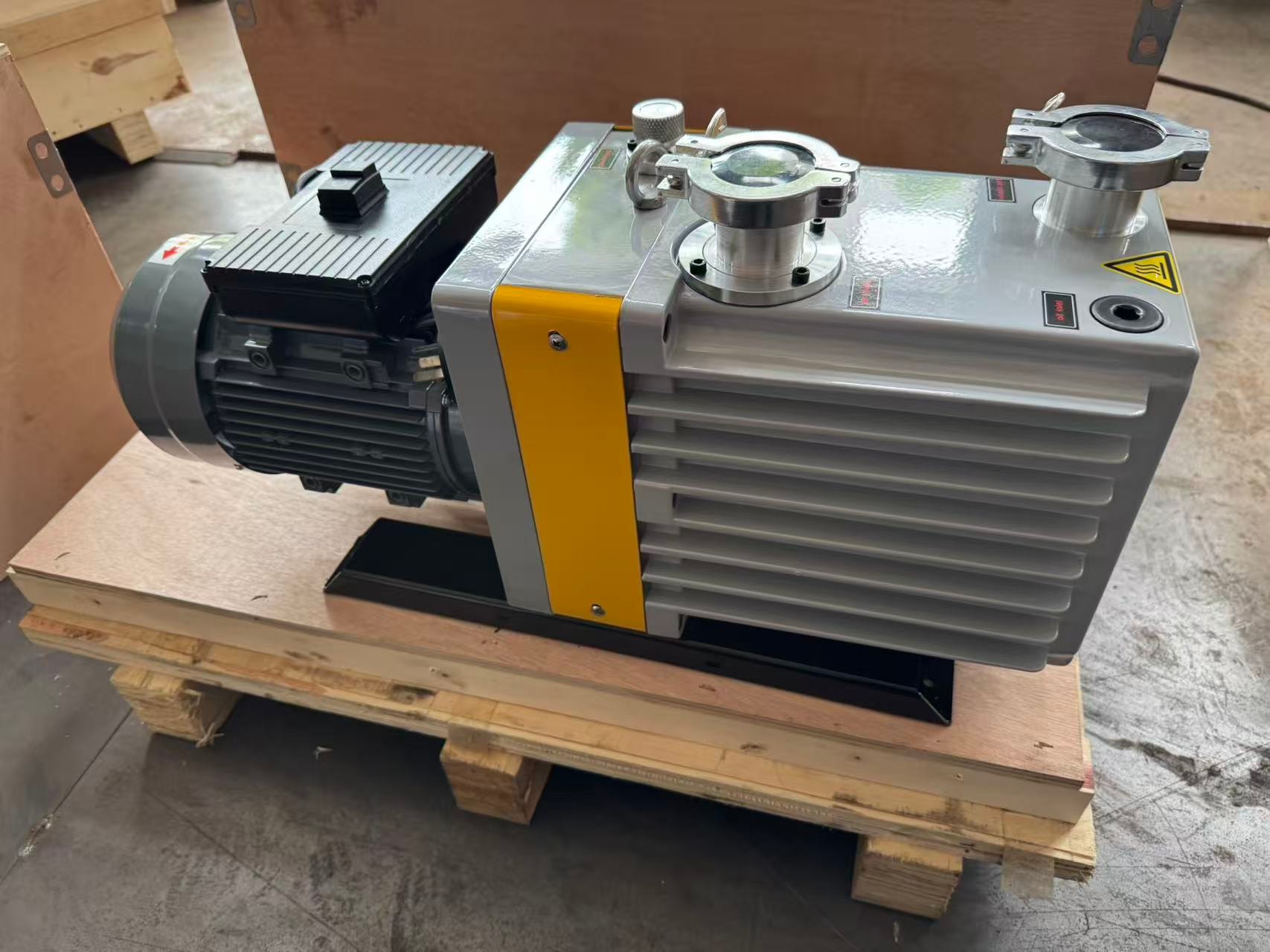
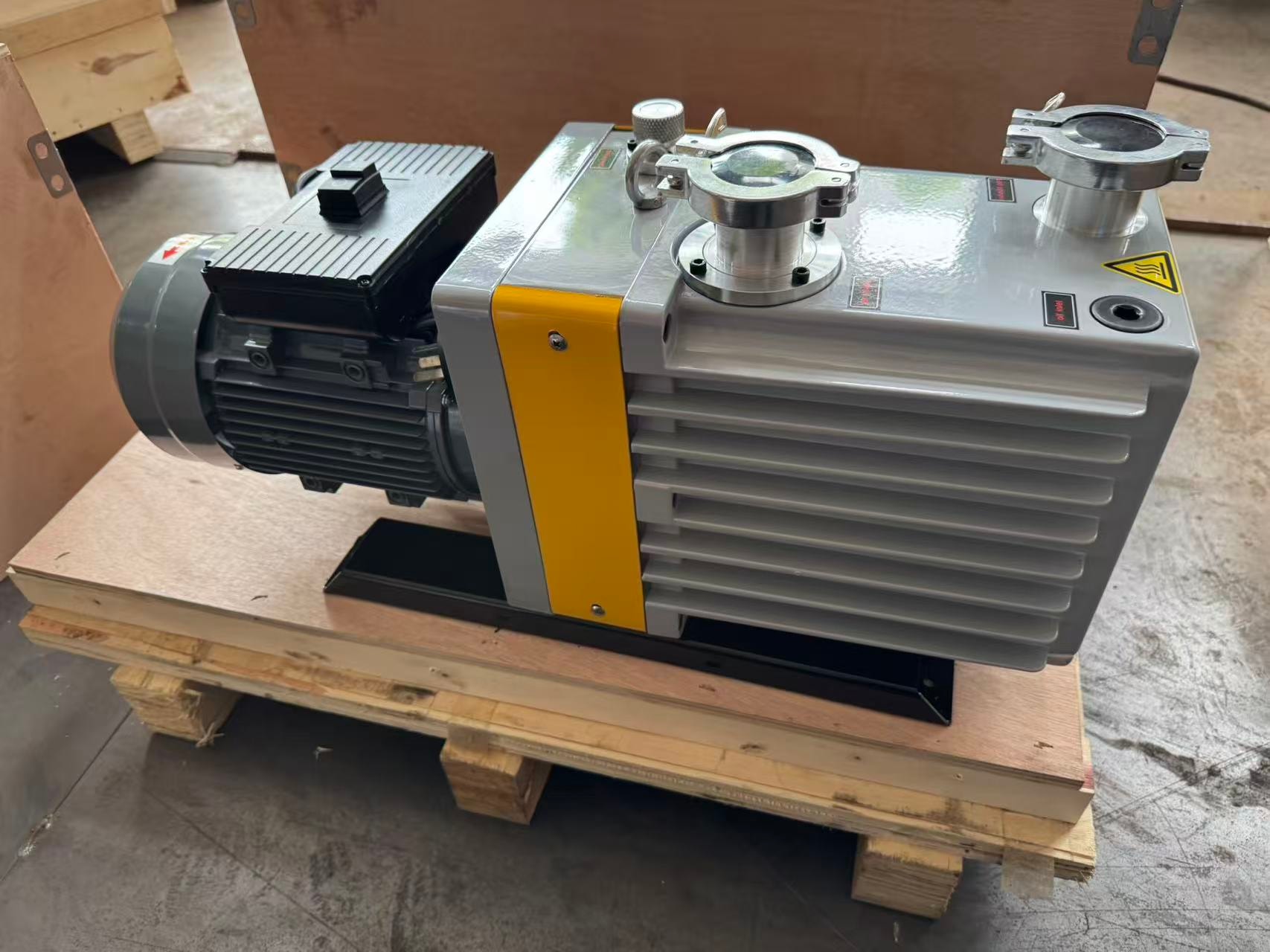
A 2XZ two-stage rotary vane vacuum pump using a compact direct-coupled motor and pump arrangement.
2XZ vs 2X: Practical Comparison
The table compares mechanical arrangements and selection requirements. It is not a model-to-model performance guarantee.
| Selection factor | 2X belt-driven configuration | 2XZ direct-coupled configuration |
|---|---|---|
| Power transmission | Motor, pulleys and drive belt | Motor-to-pump coupling; no external drive belt |
| Speed relationship | Set by motor speed and approved pulley ratio | Pump speed follows motor speed through the direct coupling |
| Drive-specific service | Belt wear, tension, alignment and guarding | Coupling condition and assembly checks specified by the manufacturer |
| Installation review | Baseplate, belt guard and transmission access | Motor/pump envelope and access for servicing |
| Ultimate pressure | Verify model, pressure definition and test conditions | Verify on the same basis as the 2X candidate |
| Continuous duty | Check the approved inlet-pressure and operating envelope | Check the approved envelope and exact lubrication variant |
| Vapor handling | Check gas-ballast availability and vapor limits | Check gas-ballast availability and vapor limits |
| Selection emphasis | Existing installation compatibility and service preference | Compact integration and avoiding external belt servicing |
The maintenance distinction follows the belt-drive service guidance and Zhongtian's direct-coupled construction documentation. The installation and selection columns are engineering considerations, not measured superiority claims. [1,2]
Does a Belt-Driven Pump Produce a Deeper Vacuum?
Not inherently. Belt drive alone is not evidence of a lower ultimate pressure.
Suppose one quotation lists 0.06 Pa and another discusses a Pirani indication near 0.6 Pa. It would be premature to conclude that the belt-driven pump produces ten times deeper vacuum. First establish whether the figures describe the same pressure quantity and were measured under comparable conditions.
Total pressure includes all gas and vapor contributions. In some rotary vane pump specifications, "ultimate partial pressure" refers to the non-condensable contribution. A Pirani gauge uses a gas-dependent thermal measurement, so its indication is not automatically interchangeable with a differently defined specification. [4,5]
Ask both suppliers to state the pressure definition, gauge and calibration basis, measurement location, oil condition, gas-ballast setting and stabilization conditions. A difference in test method may explain different numbers, but it does not automatically prove that a pump passes its specification.
The 0.06 Pa and 0.6 Pa figures above are illustrative—not a universal conversion, a new test result or a guarantee for either product family.
For a detailed explanation, see our guide to rotary vane pump ultimate pressure and Pirani readings.
Compare Pumping Speed at the Operating Pressure
Ultimate pressure and pumping speed answer different questions. Ultimate pressure concerns the limiting pressure under defined conditions. Pumping speed describes the volume-removal rate at the stated inlet conditions; the useful value for selection is the speed available around the intended operating pressure. [4,6]
Normalize the units before comparing quotations. For volumetric pumping speed, 1 L/s = 3.6 m³/h. Also confirm whether the quoted figure is nominal displacement or measured pumping speed, and whether it applies at 50 Hz or 60 Hz. Published pump data can distinguish all of these quantities. [9]
Ask for the performance curve rather than relying on the model suffix or the largest capacity number in a table. Two pumps with similar nominal capacity are not automatically equivalent throughout a pump-down cycle.
The piping matters as well. A restrictive connection, valve or separator reduces the effective pumping speed available at the chamber. Replacing the pump without reviewing that restriction may leave the system bottleneck unresolved. [6]
For a new installation, provide chamber volume, starting and target pressures, required pump-down time and any continuing gas or vapor load. For a replacement, add the existing pump data and piping dimensions.
Maintenance, Noise and Running Cost
Belt Maintenance Is Only One Part of the Comparison
A belt-driven arrangement requires attention to the belt and pulleys. Check the manufacturer's inspection, tensioning and replacement requirements, and retain the protective guard during operation. Isolate the equipment before drive servicing. [2]
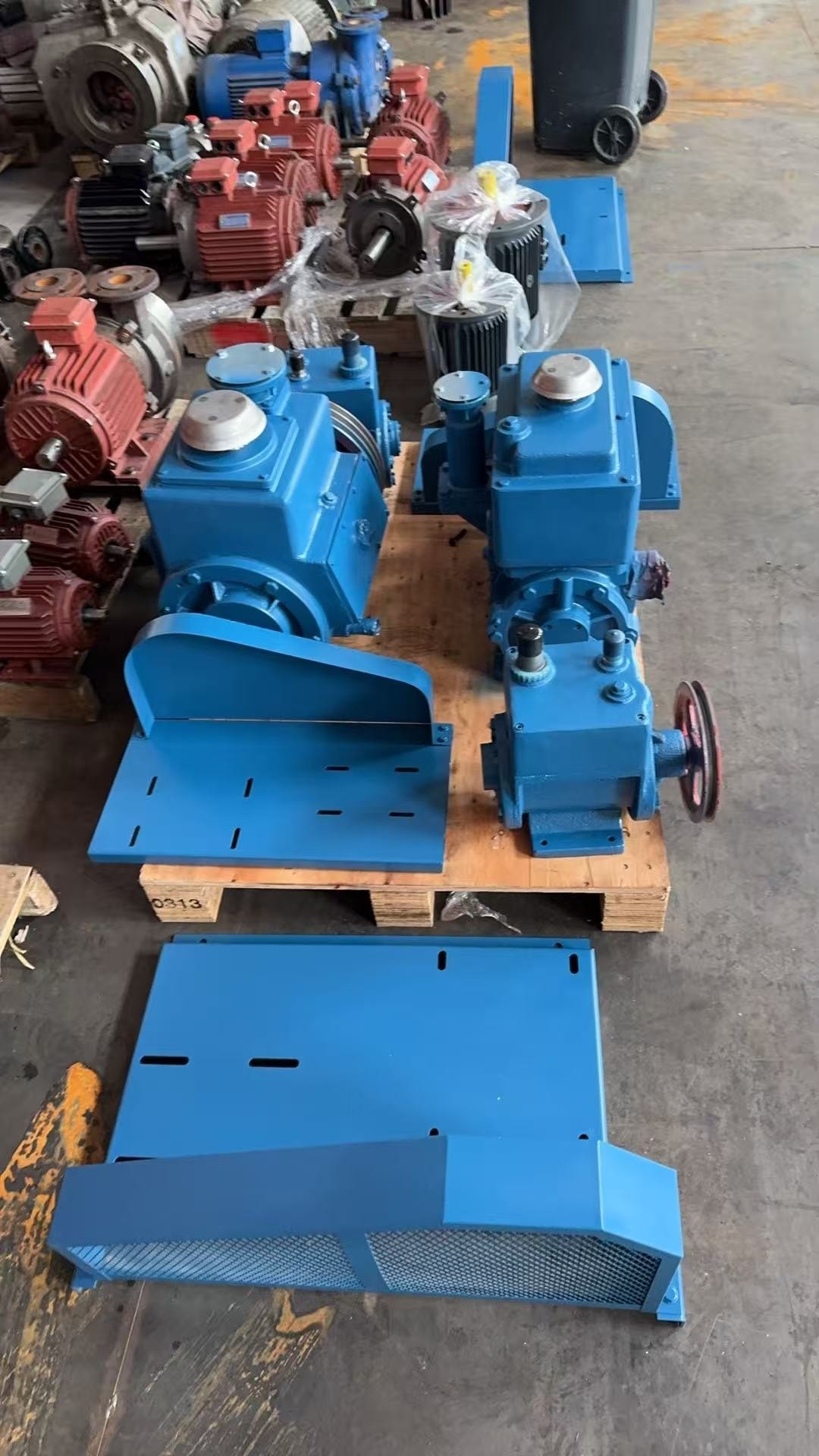
The belt-driven 2X arrangement includes external transmission components that require inspection, alignment and maintenance according to the pump manufacturer's instructions.
A direct-coupled pump avoids that belt service, but it still needs oil management, seals and other components checked according to its maintenance instructions. Zhongtian's 2XZ manual includes coupling checks and identifies contaminated oil, leaks and internal wear among possible performance problems. [1]
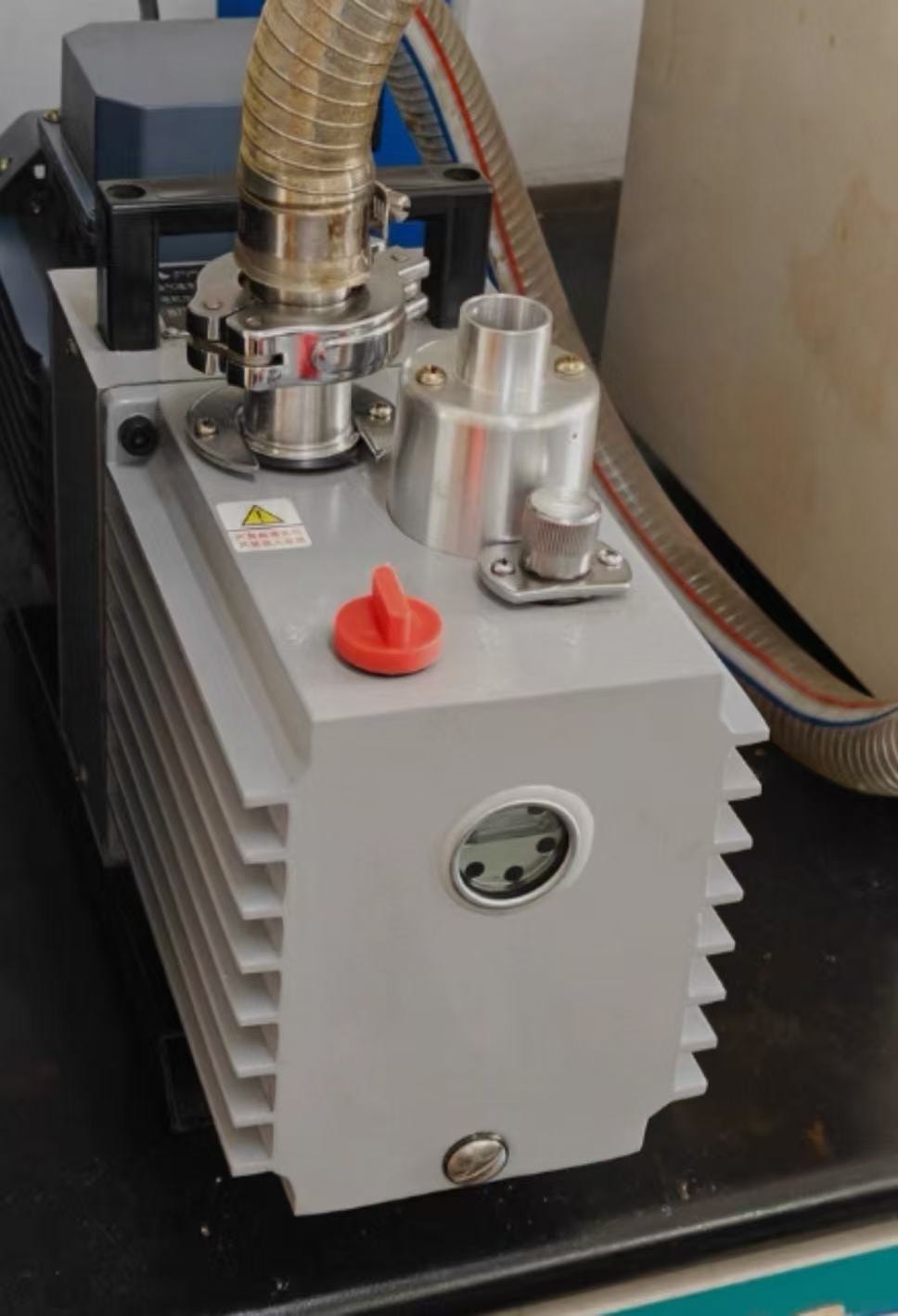
Oil level and oil condition remain important maintenance items on an oil-sealed direct-coupled rotary vane vacuum pump.
For either design, plan access for oil inspection, filling and draining, and for any fitted filters. Oil contamination can become a more important maintenance issue than the choice between a belt and a coupling. [7]
Do Not Rank Noise, Lifetime or Energy Use by Drive Type Alone
A claim that every belt-driven pump is quieter, or every direct-drive pump is more energy-efficient, needs model-specific evidence. Request comparable noise data, operating conditions and power information.
For procurement, compare measured energy over the intended cycle where available—not just installed motor power. Include oil, filters, drive parts, servicing and downtime in the ownership-cost assessment. This is a purchasing method, not a claim that either series always has the lower running cost.
Check Lubrication, Duty Cycle and Gas Compatibility
The drive mechanism is visible. The lubrication arrangement and permitted operating envelope may be less obvious, but they can determine whether a model is appropriate for the job.
The 2XZ Suffix Can Matter
Zhongtian's 2XZ operating instructions distinguish self-suction oil feed from forced oil feed supplied by an oil pump. In that manual, the "C" suffix identifies the forced-feed version. This terminology should not be assumed to apply identically to every supplier or later revision. [1]
The same instructions place operating restrictions on the self-suction configuration. Consequently, "2XZ" by itself is not enough information to approve prolonged operation at a relatively high inlet pressure. Confirm the exact variant and the current operating envelope for the supplied unit. [1]
A pump capable of reaching a low blank-off pressure is not automatically suitable for every continuous gas load. Distinguish a short atmospheric pump-down from sustained operation at elevated inlet pressure.
Gas Ballast Helps with Vapor, but It Has Limits
Where fitted and used as specified, gas ballast introduces a suitable non-condensable gas during compression to reduce vapor condensation inside the pump. It is not a liquid separator and does not make unrestricted liquid ingestion acceptable. [8]
For wet processes, assess vapor quantity, temperature, gas-ballast conditions and the possible need for upstream separation or condensation. Check ultimate-pressure requirements with the gas-ballast setting actually needed by the process. [8,9]
The Zhongtian 2XZ instructions reviewed for this guide exclude corrosive, explosive, toxic, oxygen-rich and particle-laden duties from the standard pump's stated use. Selecting a different drive arrangement is not a substitute for gas-compatibility and application review. [1]
Confirm the 50 Hz or 60 Hz Configuration
Do not treat voltage, frequency and phase as interchangeable details. Confirm all three for the exact motor and pump package.
Manufacturer data can specify different pumping speeds and power requirements at 50 Hz and 60 Hz. A frequency change must therefore be assessed for the complete assembly, not accepted because the electrical terminals appear compatible. [9]
For a belt-driven configuration, check the approved motor and pulley combination. For direct drive, confirm the permitted motor/pump speed. Neither changing a pulley nor adding a variable-frequency drive should be treated as an automatic performance upgrade.
Include the available power supply in the enquiry and request the corresponding performance data, protection requirements and installation instructions.
Can a 2XZ Replace an Existing 2X Pump?
Potentially, but it should not be assumed to be a drop-in replacement.
Begin with the required pressure and pumping performance. Then compare dimensions, mounting points, inlet and exhaust connections, electrical supply, service access and permitted operating conditions.
Rotary vane vacuum pump with a connected hose and visible oil sight glass. A replacement review should check connections and service access as well as pumping performance.
Also review shutdown behavior and the existing system's isolation arrangements. Do not assume that an anti-suckback feature is present or equivalent on every variant merely because the series name is similar. Zhongtian's instructions describe model-specific components and service checks; the supplied configuration needs to be verified. [1]
A useful replacement review includes the existing nameplate, installation photographs, current operating pressure, process description and the problem the replacement is intended to solve. "Replace the current pump" is a different requirement from "reduce pump-down time" or "handle more vapor."
Which Design Should You Choose?
Treat the following as a selection framework, subject to satisfactory model-specific performance and compatibility checks.
Consider 2XZ direct drive when a close-coupled package fits the equipment layout, external belt servicing is undesirable, and the available model meets the required pressure, capacity and duty cycle. Keep adequate cooling and service access even in a compact enclosure.
Consider 2X belt drive when the existing installation, spare-parts plan and maintenance practice favor that arrangement, and a suitable 2X model meets the process requirements. Familiarity is a valid maintenance consideration; it is not proof of inherently better vacuum performance.
Review the vacuum-system design first when excessive vapor, incompatible gas, restrictive piping or an unsuitable continuous operating point is the underlying problem. Changing the transmission arrangement alone does not address those issues. [1,6,8]
Before ordering, request the current datasheet, performance curve, dimensional drawing, oil and gas-ballast requirements, operating limits and an agreed pressure-test basis. Compare these documents before comparing price.
Frequently Asked Questions
Are 2X and 2XZ Both Two-Stage Pumps?
The conventional oil-sealed configurations compared in this guide are two-stage rotary vane pumps. The drive arrangement and number of pumping stages are separate characteristics. Check the exact manufacturer and model when comparing equipment sold under similar names.
Is a Direct-Drive Pump Maintenance-Free?
No. Removing the belt removes belt servicing—not oil changes, leak checks, coupling inspection or other model-specific maintenance. [1,7]
Can I Compare 0.06 Pa and 0.6 Pa Directly?
Only after confirming that the pressure definitions, instruments and test conditions are comparable. A difference between a partial-pressure specification and a gas-dependent gauge indication cannot be interpreted as a simple performance ratio. [4,5]
Can Either Design Operate Continuously?
Use the exact model's operating envelope. Approval must consider inlet pressure, lubrication, gas load, temperature and cooling. The series name or ultimate-pressure figure alone is insufficient. [1,9]
Does the Same Capacity Number Mean the Pumps Are Interchangeable?
No. Confirm the units, frequency, pumping-speed curve, pressure requirement, dimensions, connections and process compatibility. Similar nominal capacity is only the beginning of the comparison. [6,9]
Choose the Pump for the Process, Not the Transmission Label
The useful distinction between 2X and 2XZ is mechanical: belt drive versus direct coupling. The purchasing decision is broader.
First establish pressure, pumping performance, gas compatibility and duty cycle. Then compare installation, maintenance and ownership cost. Neither drive arrangement should be declared the universal winner without a defined application and supporting model data.
Request a 2X or 2XZ Selection Review
ZT Pumps / Nantong Zhongtian Machinery Manufacturing Co., Ltd. can review 2X belt-driven and 2XZ direct-coupled rotary vane pump options against your application requirements.
Send the required operating pressure, chamber volume, pump-down time or gas throughput, gas and vapor composition, operating temperature, duty cycle and available voltage/frequency/phase. For a replacement, include the existing pump nameplate and installation photographs.
Request a pump selection review to compare suitable configurations on a consistent technical basis.
Technical References
[1] Nantong Zhongtian Machinery Manufacturing Co., Ltd. — 2XZ Direct-Coupled Rotary Vane Vacuum Pump Operating Instructions. Supplied manufacturer document, sections 1, 2 note 3, 3, 4, 5 and 6. Revision/date not established. Used for construction, coupling, oil-feed terminology and qualitative operating restrictions; not as a current numerical performance guarantee.
[2] Welch Vacuum — Owner's Manual for DuoSeal Belt Drive Model 1376. Used for belt-drive installation and service considerations, not as specifications for ZT Pumps.
https://www.welchvacuum.com/en-nam/knowledge-base/operate-maintain/duoseal-belt-drive-model-1376-owner-manual/
[3] Leybold — TRIVAC D 4 B. Used only for the general role of oil in oil-sealed rotary vane pumps.
https://shop.leyboldus.com/products/vacuum-pumps-oil-sealed-vacuum-pumps-trivac-d4b
[4] Leybold — How is vacuum pressure measured? Used for absolute, total and partial-pressure terminology.
https://www.leybold.com/en/knowledge/vacuum-fundamentals/fundamental-physics-of-vacuum/units-and-ranges-of-pressure
[5] Leybold — How do indirect pressure vacuum gauges work? Used for gas-dependent Pirani measurement principles.
https://www.leybold.com/en-uk/knowledge/vacuum-fundamentals/vacuum-measurement/how-indirect-pressure-measurement-works
[6] Leybold — How is conductance in vacuum calculated? Used for effective pumping speed and piping restrictions.
https://www.leybold.com/en-uk/knowledge/vacuum-fundamentals/fundamental-physics-of-vacuum/how-to-calculate-vacuum-conductance
[7] Edwards Vacuum — 8 top tips for working with oil-sealed rotary vane pumps. Used for oil, contamination and maintenance considerations.
https://www.edwardsvacuum.com/en-us/vacuum-pumps/knowledge/applications/working-with-oil-sealed-rotary-vane-pumps
[8] Edwards Vacuum — The principle and application of gas ballast. Used for vapor-handling principles.
https://www.edwardsvacuum.com/en-us/vacuum-pumps/knowledge/applications/the-principle-and-application-of-gas-ballast
[9] Edwards Vacuum — E2S two-stage rotary vane pumps. Used only to illustrate why manufacturers distinguish displacement, pumping speed, frequency and gas-ballast conditions. No Edwards numerical specification is assigned to a ZT Pumps model.
https://www.edwardsvacuum.com/en-uk/vacuum-pumps/our-products/oil-rotary-vane-pumps-two-stage/e2s
Explore Topics
Written by
Zhongtian Pumps Engineering Team
The Zhongtian Pumps Engineering Team specializes in industrial vacuum pump manufacturing, application engineering and vacuum system design. Nantong Zhongtian Machinery Manufacturing Co., Ltd. has manufactured industrial vacuum equipment since 2002.